Jan 17, 2023Ravie Lakshmanan
New research has found that it is possible for threat actors to
abuse a legitimate feature in GitHub Codespaces to deliver malware
to victim systems.
GitHub Codespaces[1]
is a cloud-based configurable development environment that allows
users to debug, maintain, and commit changes to a given codebase
from a web browser or via an integration in Visual Studio Code.
It also comes with a port forwarding feature that makes it
possible to access a web application that’s running on a particular
port within the codespace directly from the browser on a local
machine for testing and debugging purposes.
“You can also forward a port manually, label forwarded ports,
share forwarded ports with members of your organization, share
forwarded ports publicly, and add forwarded ports to the codespace
configuration,” GitHub explains[2]
in its documentation.
It’s important[3]
to note here that any forwarded port that’s made public will also
permit any party with knowledge of the URL and port number to view
the running application sans any authentication.

Furthermore, GitHub Codespaces uses HTTP for port forwarding.
Should the publicly visible port be updated to use HTTPS or removed
and re-added, the port’s visibility is automatically changed to
private.
Cybersecurity firm Trend Micro found[4]
that such publicly-shared forwarded ports could be exploited to
create a malicious file server using a GitHub account.
“In the process, these abused environments will not be flagged
as malicious or suspicious even as it serves malicious content
(such as scripts, malware, and ransomware, among others), and
organizations may consider these events as benign or false
positives,” researchers Nitesh Surana and Magno Logan said.
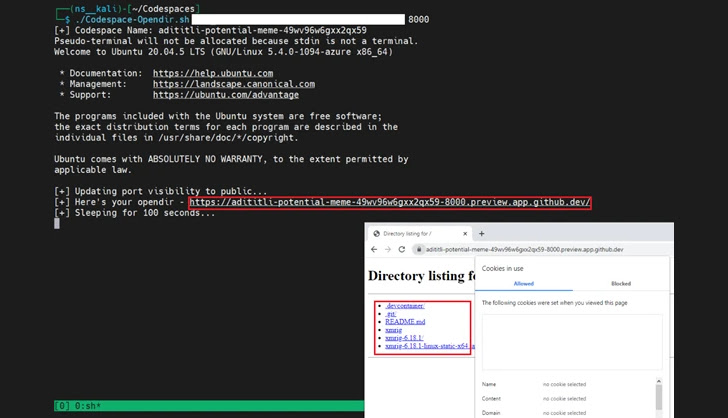
In a proof-of-concept (PoC) exploit demonstrated by Trend Micro,
a threat actor could create a codespace and download malware from
an attacker-controlled domain to the environment, and set the
visibility of the forwarded port to public, essentially
transforming the application to act as a web server hosting rogue
payloads.
Even more troublingly, the adversary can augment this method to
deploy malware and compromise a victim’s environment since each
codespace domain associated with the exposed port is unique and
unlikely to be flagged by security tools as a malicious domain.
“Using such scripts, attackers can easily abuse GitHub
Codespaces in serving malicious content at a rapid rate by exposing
ports publicly on their codespace environments,” the researchers
explained.
While the technique is yet to be observed in the wild, the
findings are a reminder as to how threat actors could weaponize[5]
cloud platforms[6]
to their benefit and carry out an array of illicit activities.
“Cloud services offer advantages to legitimate users and
attackers alike,” the researchers concluded. “The features offered
to legitimate subscribers also become available to threat actors as
they take advantage of the resources provided by the [cloud service
provider].”
Found this article interesting? Follow us on Twitter [7]
and LinkedIn[8]
to read more exclusive content we post.
References
Read more https://thehackernews.com/2023/01/hackers-can-abuse-legitimate-github.html