Dec 21, 2022Ravie Lakshmanan

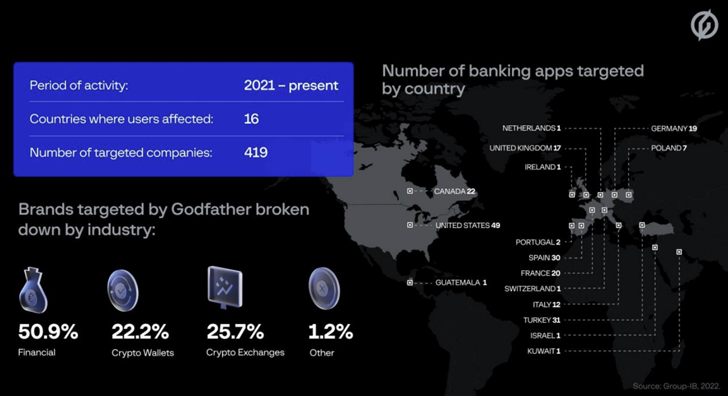
An Android banking trojan known as GodFather is
being used to target users of more than 400 banking and
cryptocurrency apps spanning across 16 countries.
This includes 215 banks, 94 crypto wallet providers, and 110
crypto exchange platforms serving users in the U.S., Turkey, Spain,
Italy, Canada, and Canada, among others, Singapore-headquartered
Group-IB said[1]
in a report shared with The Hacker News.
The malware, like many[2]
financial[3]
trojans[4]
targeting the Android ecosystem, attempts to steal user credentials
by generating convincing overlay screens (aka web fakes) that are
served atop target applications.
First detected by Group-IB in June 2021 and publicly disclosed[5]
by ThreatFabric in March 2022, GodFather also packs in native
backdoor features that allows it to abuse Android’s Accessibility
APIs to record videos, log keystrokes, capture screenshots, and
harvest SMS and call logs.
Group-IB’s analysis of the malware has revealed it to be a
successor of Anubis[6], another banking trojan
that had its source code leaked in an underground forum in January
2019. It’s also said to be distributed to other threat actors
through the malware-as-a-service (MaaS) model.
The similarities between the two malware families extend to the
method of receiving the command-and-control (C2) address,
implementation of C2 commands, and the web fake, proxy and screen
capture modules. However, audio recording and location tracking
features have been removed.
“Interestingly, GodFather spares users in post-Soviet
countries,” Group-IB said. “If the potential victim’s system
preferences include one of the languages in that region, the Trojan
shuts down. This could suggest that GodFather’s developers are
Russian speakers.”
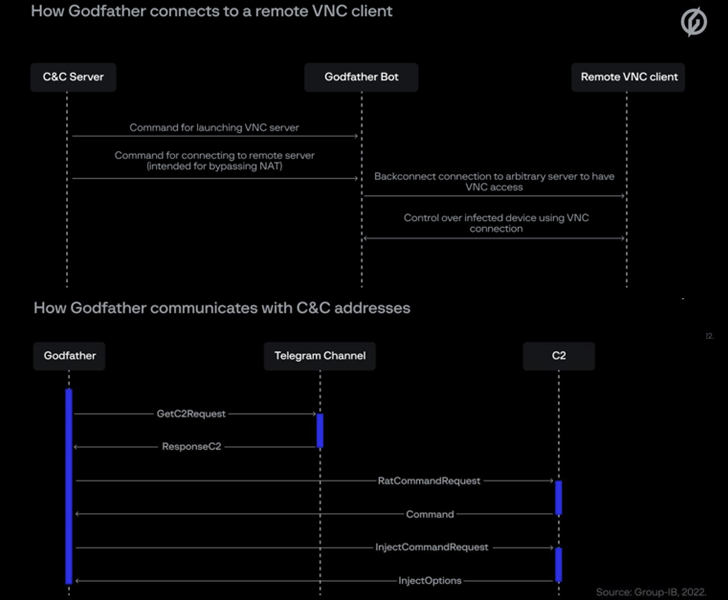
What makes GodFather stand out is the fact that it retrieves its
command-and-control (C2) server address by decrypting
actor-controlled Telegram channel descriptions that are encoded
using the Blowfish cipher[7].
The exact modus operandi employed to infect user devices is not
known, although an examination of the threat actor’s
command-and-control (C2) infrastructure reveals trojanized dropper
apps as one potential distribution vector.
This is based on a C2 address that’s linked to an app named
Currency Converter Plus (com.plus.currencyconverter) that was
hosted on the Google Play Store as of June 2022. The application in
question is no longer available for download.
Another artifact examined by Group-IB impersonates the
legitimate Google Play Protect[8]
service that, upon being launched, creates an ongoing notification[9]
and hides its icon from the list of installed applications.
The findings come as Cyble discovered[10] a number of GodFather
samples masquerading as the MYT Müzik app aimed at users in
Turkey.
GodFather is not the only Android malware based on Anubis.
Earlier this July, ThreatFabric revealed that a modified version of
Anubis known as Falcon[11] targeted Russian users
by impersonating the state-owned VTB Bank.
“The emergence of GodFather underscores the ability of threat
actors to edit and update their tools to maintain their
effectiveness in spite of efforts by malware detection and
prevention providers to update their products,” Group-IB researcher
Artem Grischenko said.
“With a tool like GodFather, threat actors are limited only by
their ability to create convincing web fakes for a particular
application. Sometimes, the sequel really can be better than the
original.”
Found this article interesting? Follow us on Twitter [12] and LinkedIn[13] to read more exclusive
content we post.
References
- ^
said
(blog.group-ib.com) - ^
many
(thehackernews.com) - ^
financial
(thehackernews.com) - ^
trojans
(thehackernews.com) - ^
publicly
disclosed (twitter.com) - ^
Anubis
(www.threatfabric.com) - ^
Blowfish
cipher (en.wikipedia.org) - ^
Google
Play Protect (developers.google.com) - ^
ongoing
notification (developer.android.com) - ^
discovered
(blog.cyble.com) - ^
Falcon
(twitter.com) - ^
Twitter
(twitter.com) - ^
LinkedIn
(www.linkedin.com)
Read more https://thehackernews.com/2022/12/godfather-android-banking-trojan.html