Dec 21, 2022Ravie Lakshmanan

Threat actors affiliated with a ransomware strain known as Play
are leveraging a never-before-seen exploit chain that bypasses
blocking rules for ProxyNotShell flaws in Microsoft Exchange Server
to achieve remote code execution (RCE) through Outlook Web Access
(OWA[1]).
“The new exploit method bypasses URL rewrite mitigations[2]
for the Autodiscover endpoint[3],” CrowdStrike
researchers Brian Pitchford, Erik Iker, and Nicolas Zilio said[4]
in a technical write-up published Tuesday.
Play ransomware, which first surfaced in June 2022, has been
revealed[5]
to adopt many tactics employed by other ransomware families such as
Hive[6]
and Nokoyawa[7], the latter of which
upgraded to Rust[8]
in September 2022.
The cybersecurity company’s investigations into several Play
ransomware intrusions found that initial access to the target
environments was not achieved by directly exploiting CVE-2022-41040[9], but rather through the
OWA endpoint.
Dubbed OWASSRF, the technique likely takes
advantage of another critical flaw tracked as CVE-2022-41080[10] (CVSS score: 8.8) to
achieve privilege escalation, followed by abusing CVE-2022-41082[11] for remote code
execution.
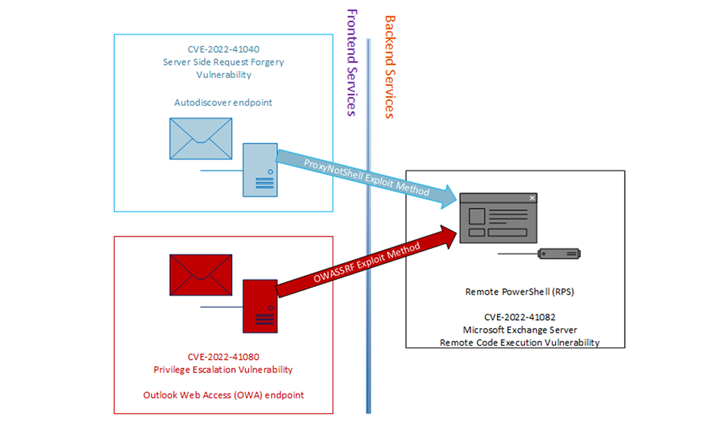
It’s worth noting that both CVE-2022-41040 and CVE-2022-41080
stem from a case of server-side request forgery (SSRF[12]), which permits an
attacker to access unauthorized internal resources, in this case
the PowerShell remoting[13] service.
CrowdStrike said the successful initial access enabled the
adversary to drop legitimate Plink and AnyDesk executables to
maintain persistent access as well as take steps to purge Windows
Event Logs on infected servers to conceal the malicious
activity.
All three vulnerabilities were addressed by Microsoft as part of
its Patch Tuesday updates[14] for November 2022.
It’s, however, unclear if CVE-2022-41080 was actively exploited as
a zero-day alongside CVE-2022-41040 and CVE-2022-41082.
The Windows maker, for its part, has tagged CVE-2022-41080 with
an “Exploitation More Likely” assessment, implying it’s possible
for an attacker to create exploit code that could be utilized to
reliably weaponize the flaw.
CrowdStrike further noted that a proof-of-concept (PoC) Python
script discovered[15] and leaked by Huntress
Labs researcher Dray Agha last week may have been put to use by the
Play ransomware actors for initial access.
This is evidenced by the fact that the execution of the Python
script made it possible to “replicate the logs generated in recent
Play ransomware attacks.”
“Organizations should apply the November 8, 2022 patches for
Exchange to prevent exploitation since the URL rewrite mitigations
for ProxyNotShell are not effective against this exploit method,”
the researchers said.
Found this article interesting? Follow us on Twitter [16] and LinkedIn[17] to read more exclusive
content we post.
References
- ^
OWA
(en.wikipedia.org) - ^
URL
rewrite mitigations (thehackernews.com) - ^
Autodiscover endpoint
(learn.microsoft.com) - ^
said
(www.crowdstrike.com) - ^
revealed
(www.trendmicro.com) - ^
Hive
(thehackernews.com) - ^
Nokoyawa
(www.trendmicro.com) - ^
upgraded
to Rust (www.zscaler.com) - ^
CVE-2022-41040
(msrc.microsoft.com) - ^
CVE-2022-41080
(msrc.microsoft.com) - ^
CVE-2022-41082
(msrc.microsoft.com) - ^
SSRF
(owasp.org) - ^
PowerShell remoting
(learn.microsoft.com) - ^
Patch
Tuesday updates (thehackernews.com) - ^
discovered
(twitter.com) - ^
Twitter
(twitter.com) - ^
LinkedIn
(www.linkedin.com)
Read more https://thehackernews.com/2022/12/ransomware-hackers-using-new-way-to.html