Dec 15, 2022Ravie Lakshmanan
NuGet, PyPi, and npm ecosystems are the target of a new campaign
that has resulted in over 144,000 packages being published by
unknown threat actors.
“The packages were part of a new attack vector, with attackers
spamming the open-source ecosystem with packages containing links
to phishing campaigns,” researchers from Checkmarx and Illustria
said[1]
in a report published Wednesday.
Of the 144,294 phishing-related packages[2] that were detected,
136,258 were published on NuGet, 7,824 on PyPi, and 212 on npm. The
offending libraries have since been unlisted or taken down.
Further analysis has revealed that the whole process was
automated and that the packages were pushed over a short span of
time, with a majority of the usernames following the convention
“<a-z><1900-2022>.”
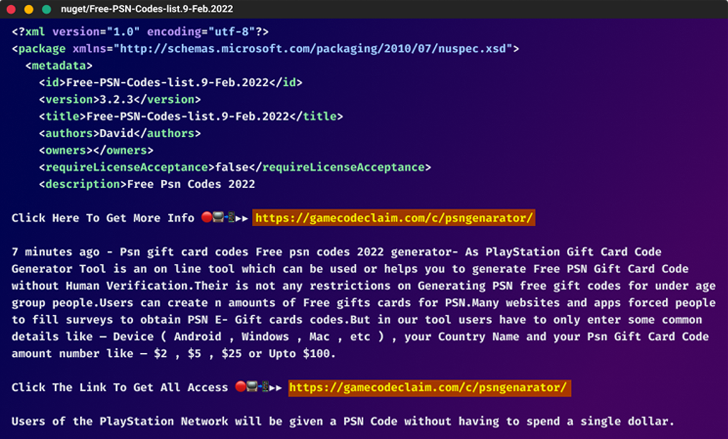
The fake packages themselves claimed to provide hacks, cheats,
and free resources in an attempt to trick users into downloading
them. The URLs to the rogue phishing pages were embedded in the
package description.
In all, the massive campaign encompassed more than 65,000 unique URLs[3]
on 90 domains.
“The threat actors behind this campaign likely wanted to improve
the search engine optimization (SEO) of their phishing sites by
linking them to legitimate websites like NuGet,” the researchers
said. “This highlights the need to be cautious when downloading
packages and only to use trusted sources.”
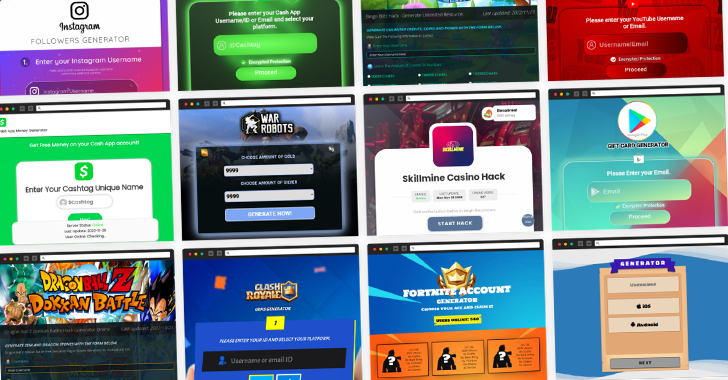
These deceptive and well-designed pages advertised game hacks,
“free money” for Cash App accounts, gift cards, and increased
followers on social media platforms like YouTube, TikTok, and
Instagram.
The sites, as is typically the case, don’t offer the promised
rewards, instead prompting users to enter email addresses and
complete surveys, before redirecting them to legitimate e-commerce
sites via an affiliate link to generate illicit referral
revenues.
The poisoning of NuGet, PyPi, and npm with fabricated packages
once again illustrates the evolving methods threat actors use to
attack the software supply chain.
“Automating the process also allowed the attackers to create a
large number of user accounts, making it difficult to trace the
source of the attack,” the researchers said. “This shows the
sophistication and determination of these attackers, who were
willing to invest significant resources in order to carry out this
campaign.”
Found this article interesting? Follow us on Twitter [4]
and LinkedIn[5]
to read more exclusive content we post.
References
- ^
said
(checkmarx.com) - ^
144,294
phishing-related packages (gist.github.com) - ^
65,000
unique URLs (gist.github.com) - ^
Twitter
(twitter.com) - ^
LinkedIn
(www.linkedin.com)
Read more https://thehackernews.com/2022/12/hackers-bombard-open-source.html