Dec 06, 2022Ravie Lakshmanan

A malicious campaign targeting the Middle East is likely linked
to BackdoorDiplomacy, an advanced persistent
threat (APT) group with ties to China.
The espionage activity, directed against a telecom company in
the region, is said to have commenced on August 19, 2021 through
the successful exploitation of ProxyShell flaws[1]
in the Microsoft Exchange Server.
Initial compromise leveraged binaries vulnerable to side-loading
techniques, followed by using a mix of legitimate and bespoke tools
to conduct reconnaissance, harvest data, move laterally across the
environment, and evade detection.
“File attributes of the malicious tools showed that the first
tools deployed by the threat actors were the NPS proxy tool and
IRAFAU backdoor,” Bitdefender researchers Victor Vrabie and Adrian
Schipor said in a report[2]
shared with The Hacker News.
“Starting in February 2022, the threat actors used another tool
– [the] Quarian backdoor, along with many other scanners and
proxy/tunneling tools.”
BackdoorDiplomacy was first documented[3]
by ESET in June 2021, with the intrusions primarily aimed at
diplomatic entities and telecommunication companies in Africa and
the Middle East to deploy Quarian (aka Turian or Whitebird).
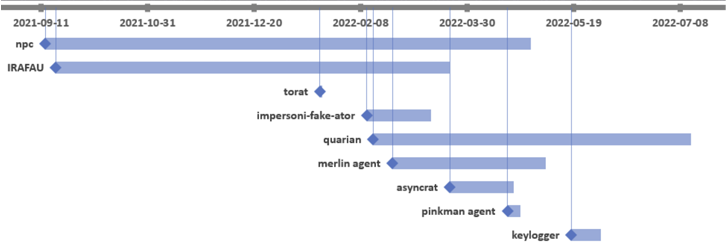
The espionage motives of the attack is evidenced by the use of
keylogger and PowerShell scripts designed to gather email content.
IRAFAU, which is the first malware component delivered after
obtaining a foothold, is used to perform information discovery and
lateral movement.
This is facilitated by downloading and uploading files from and
to a command-and-control (C2) server, launching a remote shell, and
executing arbitrary files.
The second backdoor used in the operation is an updated version
of Quarian, which comes with a broader set of capabilities to
control the compromised host.
Also put to use is a tool dubbed Impersoni-fake-ator that’s
embedded into legitimate utilities like DebugView[4]
and Putty and is engineered to capture system metadata and execute
a decrypted payload received from the C2 server.
The intrusion is further characterized by the use of open source
software such as ToRat[5], a Golang remote
administration tool, and AsyncRAT[6], the latter of which is
likely dropped via Quarian.
Bitdefender’s attribution of the attack to BackdoorDiplomacy
comes from overlaps in the C2 infrastructure identified as used by
the group in prior campaigns.
Found this article interesting? Follow us on Twitter [7]
and LinkedIn[8]
to read more exclusive content we post.
References
Read more https://thehackernews.com/2022/12/chinese-hackers-target-middle-east.html