Dec 06, 2022Ravie Lakshmanan

A persistent intrusion campaign has set its eyes on
telecommunications and business process outsourcing (BPO) companies
at lease since June 2022.
“The end objective of this campaign appears to be to gain access
to mobile carrier networks and, as evidenced in two investigations,
perform SIM swapping[1]
activity,” CrowdStrike researcher Tim Parisi said[2]
in an analysis published last week.
The financially motivated attacks have been attributed by the
cybersecurity company to an actor tracked as Scattered Spider.
Initial access to the target environment is said to be
undertaken through a variety of methods ranging from social
engineering using phone calls and messages sent via Telegram to
impersonate IT personnel.
This technique is leveraged to direct victims to a credential
harvesting site or trick them into installing commercial remote
monitoring and management (RMM) tools like Zoho Assist and
Getscreen.me.
Should the target accounts be secured by two-factor
authentication (2FA), the threat actor either convinced the victim
into sharing the one-time password or employed a technique called
prompt bombing, which was put to use in the recent breaches of
Cisco[3]
and Uber[4].
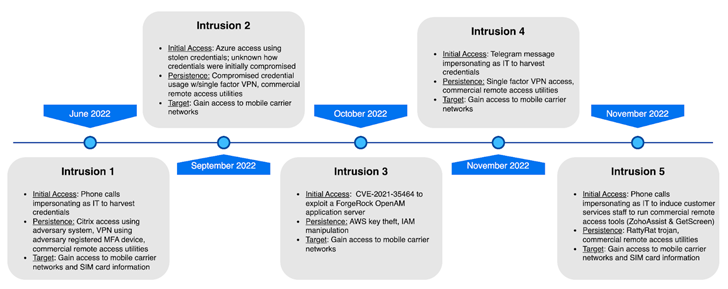
In an alternative infection chain observed by CrowdStrike, a
user’s stolen credentials previously obtained through unknown means
were used by the adversary to authenticate to the organization’s
Azure tenant.
Another instance involved the exploitation of a critical remote
code execution bug in ForgeRock OpenAM access management solution
(CVE-2021-35464[5]) that came under active
exploitation last year.
Many of the attacks also involved Scattered Spider gaining
access to the compromised entity’s multi-factor authentication
(MFA) console to enroll their own devices for persistent remote
access through legitimate remote access tools to avoid raising red
flags.
Initial access and persistence steps are followed by
reconnaissance of Windows, Linux, Google Workspace, Azure Active
Directory, Microsoft 365, and AWS environments as well as
conducting lateral movement, while also downloading additional
tools to exfiltrate VPN and MFA enrollment data in select
cases.
“These campaigns are extremely persistent and brazen,” Parisi
noted. “Once the adversary is contained or operations are
disrupted, they immediately move to target other organizations
within the telecom and BPO sectors.”
Found this article interesting? Follow us on Twitter [6]
and LinkedIn[7]
to read more exclusive content we post.
References
Read more https://thehackernews.com/2022/12/telcom-and-bpo-companies-under-attack.html