Dec 06, 2022Ravie Lakshmanan
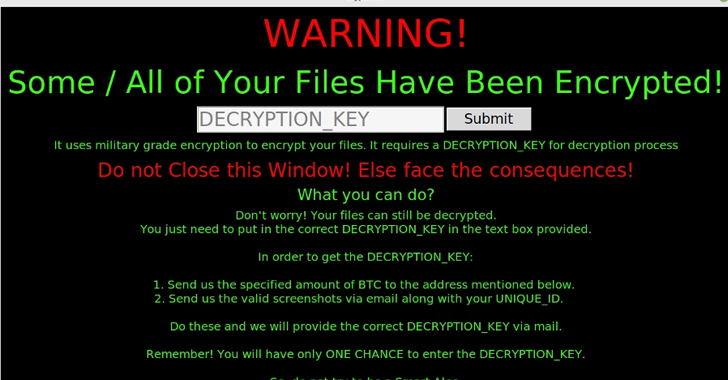
A version of an open source ransomware toolkit called
Cryptonite has been observed in the wild with
wiper capabilities due to its “weak architecture and
programming.”
Cryptonite[1], unlike other ransomware
strains, is not available for sale on the cybercriminal
underground, and was instead offered for free by an actor named
CYBERDEVILZ until recently through a GitHub repository. The source
code and its forks have since been taken down.
Written in Python, the malware employs the Fernet
module[2] of the cryptography
package to encrypt files with a “.cryptn8” extension.
But a new sample[3]
analyzed by Fortinet FortiGuard Labs has been found to lock files
with no option to decrypt them back, essentially acting as a
destructive data wiper.
But this change isn’t a deliberate attempt on part of the threat
actor, but rather stems from a lack of quality assurance that
causes the program to crash when attempting to display the ransom
note after completing the encryption process.

“The problem with this flaw is that due to the design simplicity
of the ransomware if the program crashes — or is even closed —
there is no way to recover the encrypted files,” Fortinet
researcher Gergely Revay said[4]
in a Monday write-up.
The exception thrown during the execution of the ransomware
program also means that the “key” used to encrypt the files is
never transmitted to the operators, thereby locking users out of
their data.
The findings come against the backdrop of an evolving ransomware
landscape where wipers[5]
under the guise of file-encrypting malware are being increasingly
deployed to overwrite data without allowing for decryption.
Found this article interesting? Follow us on Twitter [6]
and LinkedIn[7]
to read more exclusive content we post.
References
- ^
Cryptonite
(www.fortinet.com) - ^
Fernet
module (cryptography.io) - ^
new
sample (www.virustotal.com) - ^
said
(www.fortinet.com) - ^
wipers
(thehackernews.com) - ^
Twitter
(twitter.com) - ^
LinkedIn
(www.linkedin.com)
Read more https://thehackernews.com/2022/12/open-source-ransomware-toolkit.html