The breach of LA Unified School District (LAUSD) highlights the
prevalence of password vulnerabilities, as criminal hackers
continue to use breached credentials in increasingly frequent
ransomware attacks on education.
The Labor Day weekend breach of LAUSD brought significant
districtwide disruptions to access to
email[1], computers, and
applications. It’s unclear what student or employee data the
attackers exfiltrated.
There is a significant trend in ransomware breaches in
education, a highly vulnerable sector. The transitory nature of
students leaves accounts and passwords vulnerable. The open
environments schools create to foster student exploration and the
relative naivete in the sector regarding cybersecurity invite
attacks.
The breach at LAUSD and what happened afterward
Four days post-breach, reports came that criminals had offered
credentials for accounts inside the school district’s network
for sale on the dark web[2] months before the
attack. The stolen credentials included email addresses with the
suffix @lausd.net as the usernames and breached passwords.
LAUSD responded in its update that “compromised email
credentials reportedly found on nefarious websites were unrelated to this attack[3], as attested by federal
investigative agencies.” The LAUSD breach report confirmed the FBI
and CISA as investigators.
The FBI and CISA and facts surrounding the breach confirm that
the threat actors likely used compromised credentials to gain
initial access to the LAUSD network to assert control over
increasingly privileged passwords.
The FBI and CISA had observed the Vice Society ransomware group,
which took credit for the attack, using TTPs including “escalating privileges, then gaining access
to domain administrator accounts.”[4]
The ransomware group used scripts to change network account
passwords to prevent the victim organization from remediating the
breach.
Escalating privileges assumes attackers had privileges to
escalate, meaning they already had access and compromised passwords
at the outset of the attack.
As the FBI and CISA advisory[5]
explained, “Vice Society actors likely obtain initial network
access through compromised credentials by exploiting internet-facing
applications[6].”
The LAUSD website advises account holders to access its MyData
application at https://mydata.lausd.net[7], using their “Single
Sign-On credentials (i.e., LAUSD email username and password). One
way to make sure your Single Sign-On is working is to log on to
“Inside LAUSD” on the LAUSD homepage www.lausd.net[8].”
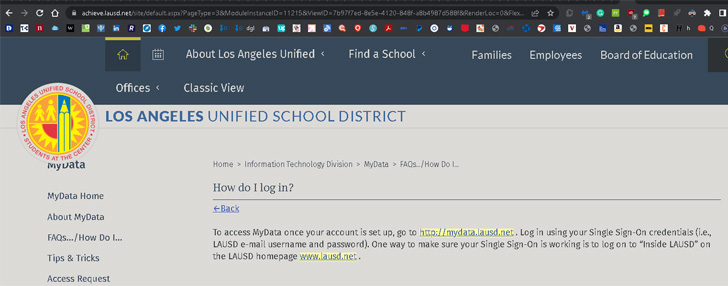 |
| LAUSD website: How do I log in? page |
The homepage, email, and SSO are exploitable internet-facing
applications. Hackers accessing email via compromised passwords
could use SSO to access data throughout the MyData application and
any application that allows access via the SSO.
After the breach, LAUSD required employees and students to
reset their passwords in person[9] on the district website
at a school district location for the @LAUSD.net email suffix
before they could log on to its systems. It’s something they would
do in case of compromised email passwords to prevent further
compromise.
The rise of ransomware attacks on education this year
Ransomware groups often target education, with effects including
unauthorized access and theft of staff and student PII. The uptake
of teachers, staff, and students working and learning online has
expanded the threat landscape, with ransomware attacks on education
trending upward since 2019. .
The FBI confirmed[10] compromised education
passwords for sale, including a dark web ad for 2,000 US university
usernames and passwords on the .edu domain suffix, in 2020. In
2021, the FBI identified 36,000 email and password combinations for
accounts on .edu domains on a publicly available instant messaging
platform.
This year, the FBI found multiple Russian cybercriminal forums
selling or revealing network credentials and VPN access to “a
multitude of identified US-based universities and colleges, some
including screenshots as proof of access.”
Beefing up security for 2023
Attackers buy and sell breached passwords on the dark web
by the millions[11], knowing that, due to
password reuse, the average credential grants access to many
accounts. Criminal hackers count on it so they can stuff breached
passwords into login pages to gain unauthorized access. That
illicit access to accounts allows hackers to gain access to
sensitive data, exploit an open network, and even inject ransomware[12].
Specops Password Policy[13] with Breached Password
Protection compares passwords in your Active Directory with over 2
billion breached passwords. Specops just added over 13 million
newly breached passwords to the list in its latest update. Specops
Breached Password Protection compares Active Directory passwords
with a continuously updated list of compromised credentials.
For each Active Directory password change or reset, Breached
Password Protection blocks the use of any compromised password with
dynamic feedback on why it was blocked. If you’re looking to secure
your educational organization, or any business for that matter,
you can test Specops Breached Password
Protection for free[14].
References
- ^
districtwide disruptions to access to
email (achieve.lausd.net) - ^
for sale
on the dark web (www.databreachtoday.com) - ^
unrelated to this attack
(thecyberwire.com) - ^
“escalating privileges, then gaining
access to domain administrator accounts.”
(www.cisa.gov) - ^
FBI and
CISA advisory (www.cisa.gov) - ^
exploiting internet-facing
applications (attack.mitre.org) - ^
https://mydata.lausd.net
(mydata.lausd.net) - ^
www.lausd.net
(www.lausd.net) - ^
reset
their passwords in person (ktla.com) - ^
FBI
confirmed (www.ic3.gov) - ^
by the
millions (gizmodo.com) - ^
inject
ransomware (securityboulevard.com) - ^
Specops Password Policy
(specopssoft.com) - ^
you
can test Specops Breached Password Protection for free
(specopssoft.com)
Read more https://thehackernews.com/2022/10/why-ransomware-in-education-on-rise-and.html