A Brazilian threat actor known as Prilex has
resurfaced after a year-long operational hiatus with an advanced
and complex malware to steal money by means of fraudulent
transactions.
“The Prilex group has shown a high level of knowledge about
credit and debit card transactions, and how software used for
payment processing works,” Kaspersky researchers said[1]. “This enables the
attackers to keep updating their tools in order to find a way to
circumvent the authorization policies, allowing them to perform
their attacks.”
The cybercrime group emerged on the scene with ATM-focused
malware attacks in the South American nation, providing it the
ability to break into ATM machines to perform jackpotting – a type
of attack aiming to dispense cash illegitimately – and clone
thousands of credit cards to steal funds from the targeted bank’s
customers.
Prilex’s modus operandi over the years has since evolved to take
advantage of processes relating to point-of-sale (PoS) software to
intercept and modify communications with electronic devices such as
PIN pads[2], which are used to
facilitate payments using debit or credit cards.
Known to be active since 2014, the operators are also adept at
carrying out EMV replay attacks[3]
in which traffic from a legitimate EMV-based chip card transaction
is captured and replayed to a payment processor like Mastercard,
but with the transaction fields modified to include stolen card
data.
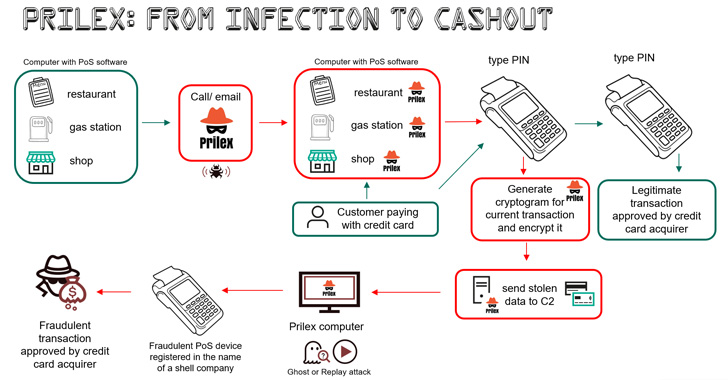
Infecting a computer with PoS software installed is a
highly-targeted attack incorporating a social engineering element
that allows the threat actor to deploy the malware.
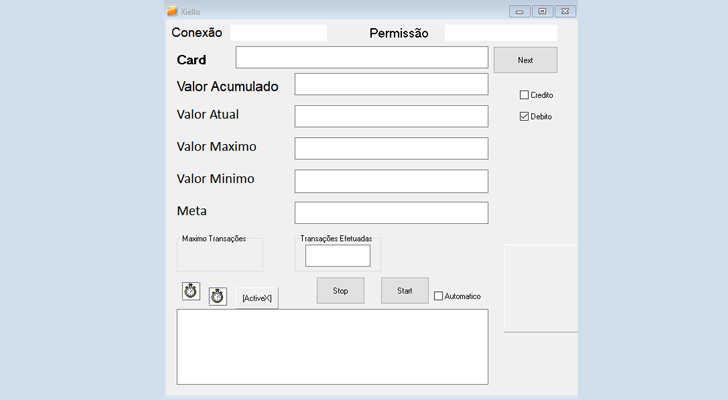
“A target business may receive a call from a ‘technician’ who
insists that the company needs to update its PoS software,” the
researchers noted. “The fake technician may visit the target in
person or request the victims to install AnyDesk and provide remote
access for the ‘technician’ to install the malware.”
The latest installments spotted in 2022, however, exhibit one
crucial difference in that the replay attacks have been substituted
with an alternative technique to illicitly cash out funds using
cryptograms generated by the victim card during the in-store
payment process.
The method, called GHOST transactions, includes a stealer
component that grabs all communications between the PoS software
and the PIN pad used for reading the card during the transaction
with the goal of obtaining the card information.
This is subsequently transmitted to a command-and-control (C2)
server, permitting the threat actor to make transactions through a
fraudulent PoS device registered in the name of a fake company.
Now, it’s worth pointing out that EMV chip cards use what’s
called a cryptogram[4]
to secure cardholder data every time a transaction is made. This is
done so as to validate the identity of the card and the approval
from the card issuer, thereby reducing the risk of counterfeit
transactions.
While previous versions of Prilex circumvented these security
measures by monitoring the ongoing transaction to get the
cryptogram and conduct a replay attack using the collected
“signature,” the GHOST attack requests for new EMV cryptograms that
are put to use to complete the rogue transactions.
Also baked into the malware is a backdoor module that’s
engineered to debug the PoS software behavior and make changes on
the fly. Other backdoor commands authorize it to terminate
processes, start and stop screen captures, download arbitrary files
from the C2 server, and execute commands using CMD.
Prilex is “dealing directly with the PIN pad hardware protocol
instead of using higher level APIs, doing real-time patching in
target software, hooking operating system libraries, messing with
replies, communications and ports, and switching from a
replay-based attack to generate cryptograms for its GHOST
transactions even from credit cards protected with CHIP and PIN
technology,” the researchers said.
References
- ^
said
(securelist.com) - ^
PIN
pads (en.wikipedia.org) - ^
EMV
replay attacks (krebsonsecurity.com) - ^
cryptogram
(thehackernews.com)
Read more https://thehackernews.com/2022/09/brazilian-prilex-hackers-resurfaced.html