An unknown Chinese-speaking threat actor has been attributed to
a new kind of sophisticated UEFI firmware rootkit called
CosmicStrand.
“The rootkit is located in the firmware images of Gigabyte or
ASUS motherboards, and we noticed that all these images are related
to designs using the H81 chipset,” Kaspersky researchers said[1]
in a new report published today. “This suggests that a common
vulnerability may exist that allowed the attackers to inject their
rootkit into the firmware’s image.”
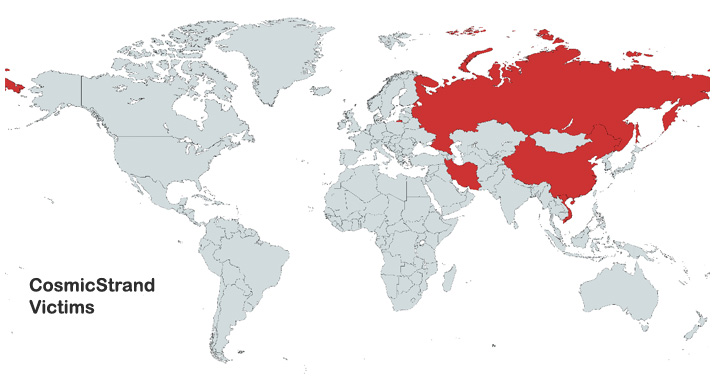
Victims identified are said to be private individuals located in
China, Vietnam, Iran, and Russia, with no discernible ties to any
organization or industry vertical. The attribution to a
Chinese-speaking threat actor stems from code overlaps between
CosmicStrand and other malware such as the MyKings botnet and
MoonBounce.
Rootkits, which are malware implants that are capable of
embedding themselves in the deepest layers of the operating system,
are morphed from a rarity to an increasingly common occurrence in
the threat landscape, equipping threat actors with stealth and
persistence for extended periods of time.
Such types of malware “ensure a computer remains in an infected
state even if the operating system is reinstalled or the user
replaces the machine’s hard drive entirely,” the researchers
said.
CosmicStrand, a mere 96.84KB file, is also the second strain of
UEFI rootkit to be discovered this year after MoonBounce[2]
in January 2022, which was deployed as part of a targeted espionage
campaign by the China-linked advanced persistent threat group
(APT41) known as Winnti.
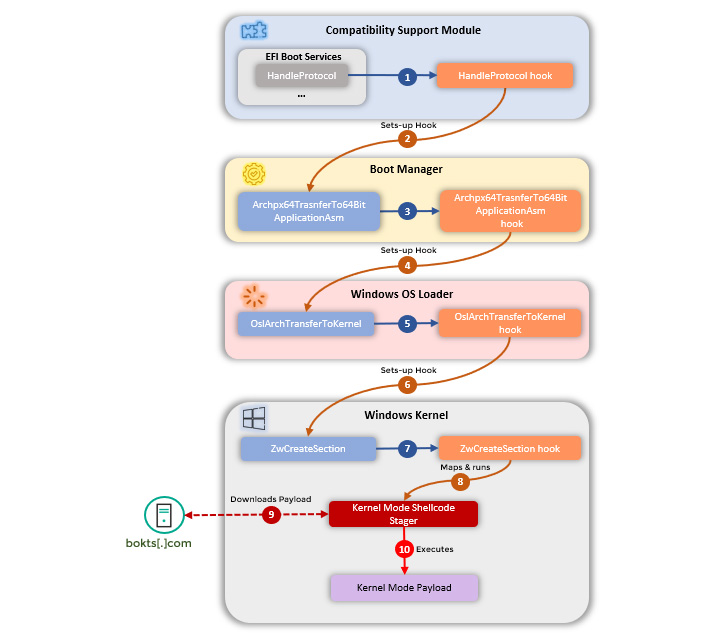
Although the initial access vector of the infections is
something of a mystery, the post-compromise actions involve
introducing changes to a driver called CSMCORE DXE to redirect code
execution to a piece of attacker-controlled segment designed to be
run during system startup, ultimately leading to the deployment of
a malware inside Windows.
In other words, the goal of the attack is to tamper with the OS
loading process to deploy a kernel-level implant into a Windows
machine every time it’s booted, using this entrenched access to
launch shellcode that connects to a remote server to fetch the
actual malicious payload to be executed on the system.
The exact nature of the next-stage malware received from the
server is unclear as yet. What’s known is that this payload is
retrieved from “update.bokts[.]com” as a series of packets
containing 528 byte-data that’s subsequently reassembled and
interpreted as shellcode.
The “shellcodes received from the [command-and-control] server
might be stagers for attacker-supplied PE executables, and it is
very likely that many more exist,” Kaspersky noted, adding it found
a total of two versions of the rootkit, one which was used between
the end of 2016 and mid-2017, and the latest variant, which was
active in 2020.
Interestingly, Chinese cybersecurity vendor Qihoo360, which shed
light on the early version of the rootkit[3] in 2017, raised the
possibility that the code modifications may have been the result of
a backdoored motherboard obtained from a second-hand reseller.
“The most striking aspect […] is that this UEFI implant seems
to have been used in the wild since the end of 2016 – long before
UEFI attacks started being publicly described,” the researchers
said. “This discovery begs a final question: if this is what the
attackers were using back then, what are they using today?”
References
- ^
said
(securelist.com) - ^
MoonBounce
(thehackernews.com) - ^
early version of the rootkit
(bbs.360.cn)
Read more https://thehackernews.com/2022/07/experts-uncover-new-cosmicstrand-uefi.html