
Microsoft is now taking steps to prevent Remote Desktop Protocol
(RDP) brute-force attacks as part of the latest builds for the
Windows 11 operating system in an attempt to raise the security baseline[1]
to meet the evolving threat landscape.
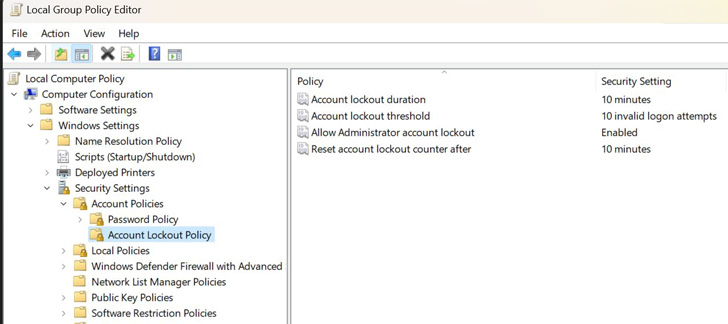
To that end, the default policy for Windows 11 builds –
particularly, Insider Preview builds 22528.1000 and newer – will
automatically lock accounts for 10 minutes after 10 invalid sign-in
attempts.
“Win11 builds now have a DEFAULT account lockout policy to
mitigate RDP and other brute-force password vectors,” David Weston,
Microsoft’s vice president for OS security and enterprise, said[2]
in a series of tweets last week. “This technique is very commonly
used in Human Operated Ransomware and other attacks — this control
will make brute forcing much harder which is awesome!”
It’s worth pointing out that while this account lockout setting[3]
is already incorporated in Windows 10, it’s not enabled by
default.
The feature, which follows the company’s decision to resume blocking[4]
of Visual Basic Application (VBA) macros for Office documents, is
also expected to be backported to older versions of Windows and
Windows Server.
Aside from malicious macros, brute-forced RDP access has long
been one of the most[5]
popular[6]
methods[7]
used by threat actors to gain unauthorized access to Windows
systems.
LockBit[8], which is one of the
most active ransomware gangs of 2022, is known to often rely on RDP
for initial foothold and follow-on activities. Other families seen
using the same mechanism include Conti[9], Hive[10], PYSA[11], Crysis[12], SamSam, and Dharma[13].
In implementing this new threshold, the objective is to
significantly diminish the effectiveness of the RDP attack vector
and forestall intrusions that rely on password-guessing and
compromised credentials.
“Brute-forcing RDP is the most common method used by threat
actors attempting to gain access to Windows systems and execute
malware, ” Zscaler noted last year.
“Threat actors scan for […] publicly open RDP ports to conduct
distributed brute-force attacks. Systems that use weak credentials
are easy targets, and, once compromised, attackers sell access to
the hacked systems on the dark web to other cybercriminals.”
That said, Microsoft, in its documentation, warns of potential
denial-of-service (DoS) attacks that could be orchestrated by
abusing the Account lockout threshold policy setting.
“A malicious user could programmatically attempt a series of
password attacks against all users in the organization,” the
company notes[14]. “If the number of
attempts is greater than the value of Account lockout threshold,
the attacker could potentially lock every account.”
References
- ^
security
baseline (docs.microsoft.com) - ^
said
(twitter.com) - ^
account
lockout setting (docs.microsoft.com) - ^
resume
blocking (thehackernews.com) - ^
most
(www.bitdefender.com) - ^
popular
(securelist.com) - ^
methods
(blog.malwarebytes.com) - ^
LockBit
(thehackernews.com) - ^
Conti
(thehackernews.com) - ^
Hive
(thehackernews.com) - ^
PYSA
(thehackernews.com) - ^
Crysis
(www.trendmicro.com) - ^
SamSam, and Dharma
(www.zscaler.com) - ^
notes
(docs.microsoft.com)
Read more https://thehackernews.com/2022/07/microsoft-adds-default-protection.html