A suspected state-aligned threat actor has been attributed to a
new set of attacks exploiting the Microsoft Office “Follina”
vulnerability to target government entities in Europe and the
U.S.
Enterprise security firm Proofpoint said it blocked attempts at
exploiting the remote code execution flaw, which is being tracked
CVE-2022-30190[1]
(CVSS score: 7.8). No less than 1,000 phishing messages containing
a lure document were sent to the targets.
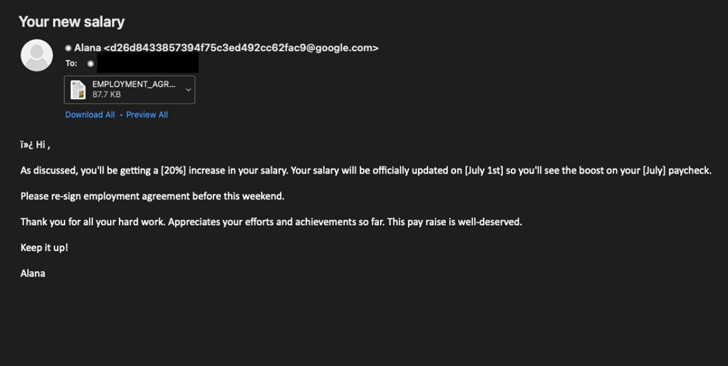
“This campaign masqueraded as a salary increase and utilized an
RTF with the exploit payload downloaded from 45.76.53[.]253,” the
company said[2]
in a series of tweets.
The payload, which manifests in the form of a PowerShell script,
is Base64-encoded and functions as a downloader to retrieve a
second PowerShell script from a remote server named
“seller-notification[.]live.”
“This script checks for virtualization, steals information from
local browsers, mail clients and file services, conducts machine
recon and then zips it for exfil[tration] to 45.77.156[.]179,” the
company added.
The phishing campaign has not been linked to a previously known
group, but said it was mounted by a nation-state actor based on the
specificity of the targeting and the PowerShell payload’s
wide-ranging reconnaissance capabilities.
The development follows active exploitation attempts[3] by a Chinese threat
actor tracked as TA413 to deliver weaponized ZIP archives with
malware-rigged Microsoft Word documents.
The Follina vulnerability, which leverages the “ms-msdt:”
protocol URI scheme to remotely take control of target devices,
remains unpatched, with Microsoft urging customers to disable the protocol[4]
to prevent the attack vector.
“Proofpoint continues to see targeted attacks leveraging
CVE-2022-30190,” Sherrod DeGrippo, vice president of threat
research, said in a statement shared with The Hacker News.
“The extensive reconnaissance conducted by the second PowerShell
script demonstrates an actor interested in a large variety of
software on a target’s computer. This, coupled with the tight
targeting of European government and local U.S. governments led us
to suspect this campaign has a state aligned nexus.”
References
- ^
CVE-2022-30190
(thehackernews.com) - ^
said
(twitter.com) - ^
active
exploitation attempts (thehackernews.com) - ^
disable
the protocol (thehackernews.com)
Read more https://thehackernews.com/2022/06/state-backed-hackers-exploit-microsoft.html