The U.S. Cybersecurity and Infrastructure Security Agency (CISA)
and Food and Drug Administration (FDA) have issued an advisory
about critical security vulnerabilities in Illumina’s
next-generation sequencing (NGS[1]) software.
Three of the flaws are rated 10 out of 10 for severity on the
Common Vulnerability Scoring System (CVSS[2]), with two others having
severity ratings of 9.1 and 7.4.
The issues impact software in medical devices used for “clinical
diagnostic use in sequencing a person’s DNA or testing for various
genetic conditions, or for research use only,” according to the FDA[3].
“Successful exploitation of these vulnerabilities may allow an
unauthenticated malicious actor to take control of the affected
product remotely and take any action at the operating system
level,” CISA said[4]
in an alert.
“An attacker could impact settings, configurations, software, or
data on the affected product and interact through the affected
product with the connected network.”
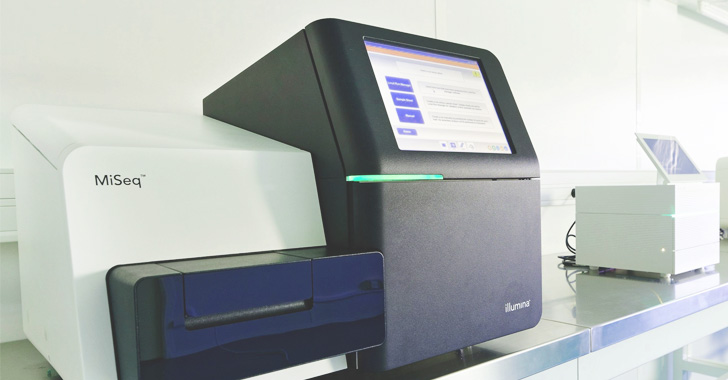
Affected devices and instruments include NextSeq 550Dx, MiSeq
Dx, NextSeq 500, NextSeq 550, MiSeq, iSeq 100, and MiniSeq using
Local Run Manager (LRM) software versions 1.3 to 3.1.
The list of flaws is as follows –
- CVE-2022-1517 (CVSS score: 10.0) – A remote
code execution vulnerability at the operating system level that
could allow an attacker to tamper with settings and access
sensitive data or APIs. - CVE-2022-1518 (CVSS score: 10.0) – A directory
traversal vulnerability that could allow an attacker to upload
malicious files to arbitrary locations. - CVE-2022-1519 (CVSS score: 10.0) – An issue
with the unrestricted upload of any file type, allowing an attacker
to achieve arbitrary code execution. - CVE-2022-1521 (CVSS score: 9.1) – A lack of
authentication in LRM by default, enabling an attacker to inject,
modify, or access sensitive data. - CVE-2022-1524 (CVSS score: 7.4) – A lack of
TLS encryption for LRM versions 2.4 and lower that could be abused
by an attacker to stage a man-in-the-middle (MitM) attack and
access credentials.
In addition to permitting remote control over the instruments,
the flaws could be weaponized to compromise patients’ clinical
tests, resulting in incorrect or altered results during
diagnosis.
While there is no evidence that the flaws are being exploited in
the wild, it’s recommended that customers apply the software patch[5]
released by Illumina last month to mitigate any potential risk.
References
- ^
NGS
(www.illumina.com) - ^
CVSS
(en.wikipedia.org) - ^
according to the FDA
(www.fda.gov) - ^
said
(www.cisa.gov) - ^
software
patch (support.illumina.com)
Read more https://thehackernews.com/2022/06/cisa-warned-about-critical.html