
Luxury hotels in the Chinese special administrative region of
Macau were the target of a malicious spear-phishing campaign from
the second half of November 2021 and through mid-January 2022.
Cybersecurity firm Trellix attributed[1]
the campaign with moderate confidence to a suspected South Korean
advanced persistent threat (APT) tracked as DarkHotel, building on
research previously published by Zscaler[2]
in December 2021.
Believed to be active since 2007, DarkHotel has a history of
striking “senior business executives by uploading malicious code to
their computers through infiltrated hotel Wi-Fi networks, as well
as through spear-phishing and P2P attacks,” Zscaler researchers
Sahil Antil and Sudeep Singh said. Prominent sectors targeted
include law enforcement, pharmaceuticals, and automotive
manufacturers.
The attack chains involved distributing email messages directed
to individuals in executive roles in the hotel, such as the vice
president of human resources, assistant manager, and front office
manager, indicating that the intrusions were aimed at staff who
were in possession of access to the hotel’s network.
In one phishing lure sent to 17 different hotels on December 7,
the email purported to be from the Macau Government Tourism Office
and urged the victims to open an Excel file named “信息.xls”
(“information.xls”). In another case, the emails were faked to
gather details about people staying in the hotels.
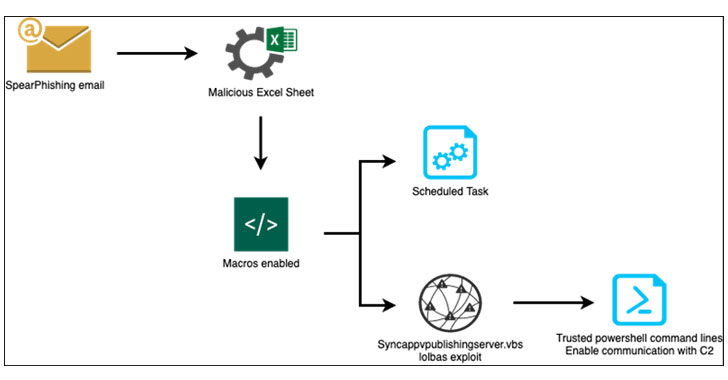
The malware-laced Microsoft Excel file, when opened, tricked the
recipients into enabling macros, triggering an exploit chain to
gather and exfiltrate sensitive data from the compromised machines
back to a remote command-and-control (C2) server (“fsm-gov[.]com”)
that impersonated the government website for the Federated States
of Micronesia (FSM).
“This IP was used by the actor to drop new payloads as first
stages to set up the victim environment for system information
exfiltration and potential next steps,” Trellix researchers
Thibault Seret and John Fokker said in a report published last
week. “Those payloads were used to target major hotel chains in
Macau, including the Grand Coloane Resort and Wynn Palace.”
Also noteworthy is the fact that the C2 server IP address has
continued to remain active despite prior public disclosure and that
it’s also being used to serve phishing pages for an unrelated
credential harvesting attack directed at MetaMask cryptocurrency
wallet users.
The campaign is said to have to met its inevitable end on
January 18, 2022 coinciding with the rise of COVID-19 cases in
Macau, prompting the cancelation or postponement of international
trade conferences that were set to take place in the targeted
hotels.
“The group was trying to lay the foundation for a future
campaign involving these specific hotels,” the researchers said.
“In this campaign, the COVID-19 restrictions threw a wrench in the
threat actor’s engine, but that doesn’t mean they have abandoned
this approach.”
References
- ^
attributed
(www.trellix.com) - ^
Zscaler
(www.zscaler.com)
Read more https://thehackernews.com/2022/03/south-korean-darkhotel-hackers-targeted.html