
Researchers have exposed a new targeted email campaign aimed at
French entities in the construction, real estate, and government
sectors that leverages the Chocolatey Windows package manager to
deliver a backdoor called Serpent on compromised
systems.
Enterprise security firm Proofpoint attributed the attacks to a
likely advanced threat actor based on the tactics and the
victimology patterns observed. The ultimate objective of the
campaign remains presently unknown.
“The threat actor attempted to install a backdoor on a potential
victim’s device, which could enable remote administration, command
and control (C2), data theft, or deliver other additional
payloads,” Proofpoint researchers said[1]
in a report shared with The Hacker News.
The phishing lure that triggers the infection sequence makes use
of a resume-themed subject line, with the attached macro-embedded
Microsoft Word document masquerading as information related to the
European Union’s General Data Protection Regulation (GDPR).
Enabling the macros results in its execution, which retrieves a
seemingly harmless image file hosted on a remote server but
actually contains a Base64-encoded PowerShell script that’s
obscured using steganography, a little-used method of concealing
malicious code within an image or audio in order to circumvent
detection.
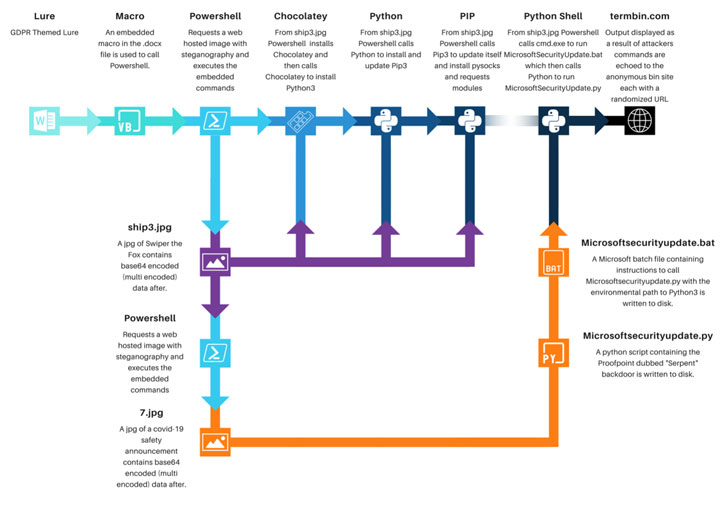
The PowerShell script, in turn, is engineered to install the
Chocolatey
utility[2] on the Windows machine,
which is then utilized to install the Python package installer
pip[3], the latter of which
acts as conduit to install the PySocks[4] proxy library.
Also retrieved by the same PowerShell script is another image
file from the same remote server that includes the camouflaged
Python backdoor dubbed Serpent, which comes with capabilities to
execute commands transmitted from the C2 server.
In addition to steganography, the use of widely recognized tools
such as Chocolatey as an initial payload for follow-on deployment
of genuine Python packages is an attempt to stay under the radar
and not be flagged as a threat, Proofpoint said.
The attacks have not unearthed associations with a previously
identified actor or group, but are suspected to be the work of a
sophisticated hacking crew.
“This is a novel application of a variety of technologies that
are often legitimately used within organizations,” Sherrod
DeGrippo, vice president of threat research and detection at
Proofpoint, said in a statement.
“It capitalizes on many organizations’, specifically technical
groups, desire to allow their users to be ‘self-sufficient’ in
regards to self-tooling and package managers. Additionally, the use
of steganography is unusual and something we don’t see
regularly.”
References
Read more https://thehackernews.com/2022/03/new-backdoor-targets-french-entities.html