
Details of a new nation-state sponsored phishing campaign have
been uncovered setting its sights on European governmental entities
in what’s seen as an attempt to obtain intelligence on refugee and
supply movement in the region.
Enterprise security company Proofpoint, which detected the
malicious emails for the first time on February 24, 2022, dubbed
the social engineering attacks “Asylum
Ambuscade.”
“The email included a malicious macro attachment which utilized
social engineering themes pertaining to the Emergency Meeting of
the NATO Security Council held on February 23, 2022,” researchers
Michael Raggi and Zydeca Cass said[1]
in a report published Tuesday.
“The email also contained a malicious attachment which attempted
to download malicious Lua malware named SunSeed and targeted
European government personnel tasked with managing transportation
and population movement in Europe.”
The findings build on an advisory[2]
issued by the State Service of Special Communication and
Information Protection of Ukraine (DSSZZI), which warned last week
of phishing messages targeting its military personnel with ZIP file
attachments with the goal of stealing sensitive personal
information.
Proofpoint declined to attribute the newly observed campaign to
a specific threat actor, but noted that the overlaps in the
timeline of the two sets of attacks, the phishing lures used, and
the victimology patterns aligns with that of a Belarusian
nation-state group called UNC1151[3]
(aka TA445 or Ghostwriter).
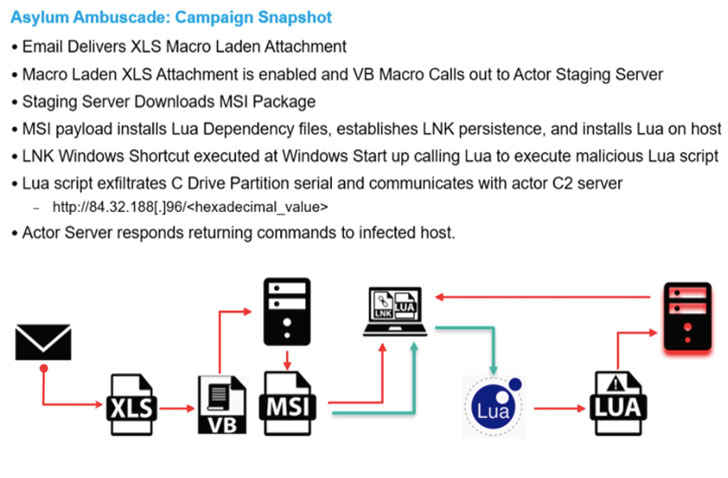
One of the notable aspects of Asylum Ambuscade is the likely use
of a compromised Ukrainian armed service member’s email account to
broadcast malware-laced email messages containing a macro-enabled
XLS file that delivers SunSeed onto infected hosts, implying that
the latest campaign may be a continuation of these attacks.
“The social engineering lures utilized in this phishing campaign
were very timely, following a NATO Security Council meeting[4] on February 23, 2022 and
a news story about a Russian government ‘kill list’ targeting
Ukrainians that began circulating in Western[5]
media outlets[6]
on February 21, 2022,” the researchers noted.
SunSeed, for its part, functions as a downloader that
establishes communications with an actor-controlled server to
retrieve next-stage payloads for execution.
The Sunnyvale-based cybersecurity company noted that the attacks
specifically singled out individuals who were tasked with
responsibilities related to transportation, financial and budget
allocation, administration, and population movement within
Europe.
The disclosure comes as Russia’s intensifying military invasion
of Ukraine has polarized[7]
cyberspace, with hacktivists, cybercriminals, white hat
researchers, and technology companies picking a side[8]
in the conflict.
In a separate update posted earlier today, Ukraine’s Computer
Emergency Response Team (CERT-UA) described[9]
the ongoing developments as an “information and psychological war,”
urging people in the country to carefully monitor their accounts
for unrecognized devices, turn on two-factor authentication, and
use end-to-end encrypted messaging apps.
What’s more, email security company Avanan said[10] it witnessed an
eightfold increase in email-borne attacks originating from Russia
starting on February 27, at least some of them targeting
manufacturing, international shipping, and transportation companies
located in the U.S. and Europe.
“In light of the ongoing Russia-Ukraine war, actions by proxy
actors like TA445 will continue to target European governments to
gather intelligence around the movement of refugees from Ukraine
and on issues of importance to the Russian government,” the
researchers said.
References
- ^
said
(www.proofpoint.com) - ^
advisory
(www.facebook.com) - ^
UNC1151
(thehackernews.com) - ^
NATO
Security Council meeting (www.un.org) - ^
Western
(www.bbc.com) - ^
media
outlets (www.nytimes.com) - ^
polarized
(blog.checkpoint.com) - ^
picking
a side (thehackernews.com) - ^
described
(www.facebook.com) - ^
said
(www.avanan.com)
Read more https://thehackernews.com/2022/03/hackers-try-to-hack-european-officials.html