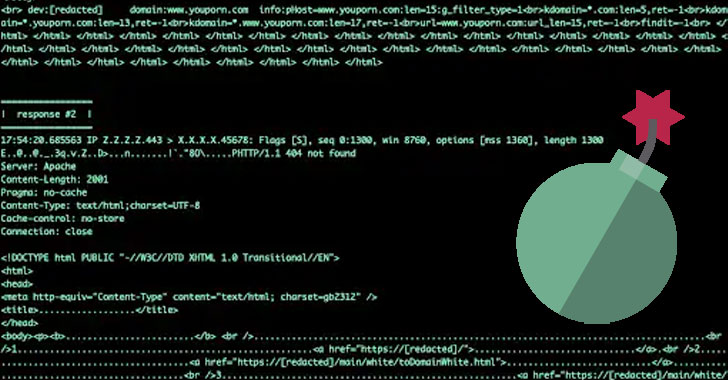
Distributed denial-of-service (DDoS) attacks leveraging a new
amplification technique called TCP Middlebox Reflection have
been detected for the first time in the wild, six months after the
novel attack mechanism was presented in theory.
“The attack […] abuses vulnerable firewalls and content
filtering systems to reflect and amplify TCP traffic to a victim
machine, creating a powerful DDoS attack,” Akamai researchers
said[1]
in a report published Tuesday.
“This type of attack dangerously lowers the bar for DDoS
attacks, as the attacker needs as little as 1/75th (in some cases)
the amount of bandwidth from a volumetric standpoint,” the
researchers added.
A distributed reflective denial-of-service (DRDoS[2]) is a form of
distributed denial-of-service (DDoS) attack that relies on publicly
accessible UDP servers and bandwidth amplification factors (BAFs)
to overwhelm a victim’s system with a high volume of UDP
responses.
In these attacks, the adversary sends a flood of DNS or NTP
requests containing a forged source IP address to the targeted
asset, causing the destination server to deliver the responses back
to the host residing at the spoofed address in an amplified manner
that exhausts the bandwidth issued to the target.
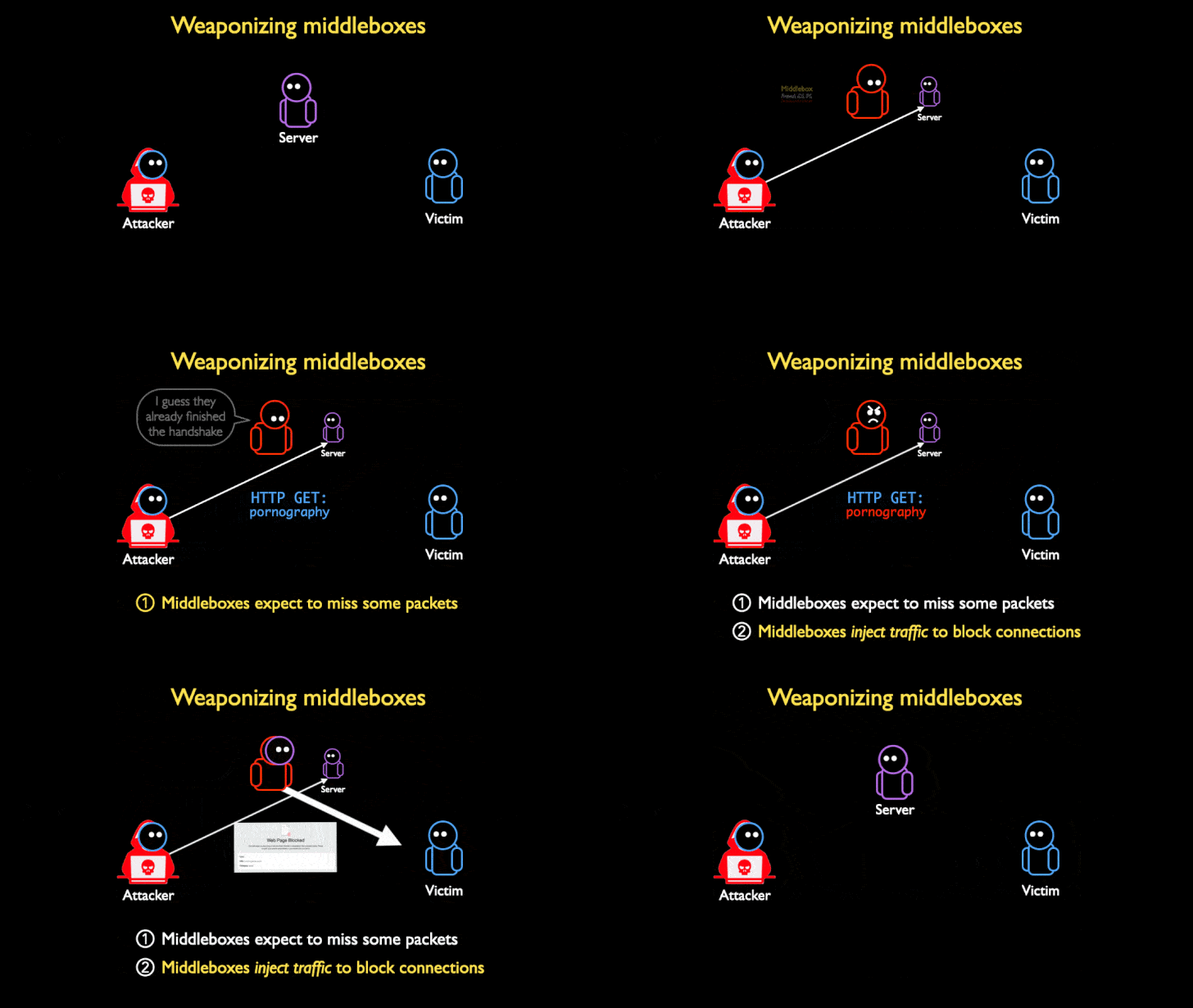
The development comes following an academic study[3]
published in August 2021 about a new attack vector that exploits
weaknesses in the implementation of TCP protocol in middleboxes[4]
and censorship infrastructure to stage reflected denial of service
(DoS) amplification attacks against targets.
While DoS amplification attacks have traditionally abused UDP
reflection vectors – owing to the connectionless nature of the
protocol – the novel attack technique takes advantage of TCP
non-compliance in middleboxes such as deep packet inspection
(DPI[5]) tools to stage
TCP-based reflective amplification attacks.
The first wave of “noticeable” attack campaigns taking advantage
of the technique is said to have occurred around February 17,
striking Akamai customers across banking, travel, gaming, media,
and web hosting industries with high amounts of traffic that peaked
at 11 Gbps at 1.5 million packets per second (Mpps).
“The vector has been seen used alone and as part of multi-vector
campaigns, with the sizes of the attacks slowly climbing,” Chad
Seaman, lead of the security intelligence research team (SIRT) at
Akamai, told The Hacker News.
The core idea with TCP-based reflection is to leverage the
middleboxes that are used to enforce censorship laws and enterprise
content filtering policies by sending specially crafted TCP packets
to trigger a volumetric response.
Indeed, in one of the attacks observed by the cloud security
company, a single SYN packet with a 33-byte payload triggered a
2,156-byte response, effectively achieving an amplification factor
of 65x (6,533%).
“The main takeaway is that the new vector is starting to see
real world abuse in the wild,” Seaman said. “Typically, this is a
signal that more widespread abuse of a particular vector is likely
to follow as knowledge and popularity grows across the DDoS
landscape and more attackers begin to create tooling to leverage
the new vector.”
“Defenders need to be aware that we’ve moved from theory to
practice, and they should review their defensive strategies in
accordance with this new vector, which they may be seeing in the
real world soon,” Seaman added.
References
- ^
said
(www.akamai.com) - ^
DRDoS
(www.cisa.gov) - ^
academic
study (thehackernews.com) - ^
middleboxes
(en.wikipedia.org) - ^
DPI
(en.wikipedia.org)
Read more https://thehackernews.com/2022/03/hackers-begin-weaponizing-tcp-middlebox.html