A new malware capable of controlling social media accounts is
being distributed through Microsoft’s official app store in the
form of trojanized gaming apps, infecting more than 5,000 Windows
machines in Sweden, Bulgaria, Russia, Bermuda, and Spain.
Israeli cybersecurity company Check Point dubbed the malware
“Electron Bot,” in reference to a command-and-control (C2) domain
used in recent campaigns. The identity of the attackers is not
known, but evidence suggests that they could be based out of
Bulgaria.
“Electron Bot is a modular SEO poisoning malware, which is used
for social media promotion and click fraud,” Check Point’s Moshe
Marelus said[1]
in a report published this week. “It is mainly distributed via the
Microsoft store platform and dropped from dozens of infected
applications, mostly games, which are constantly uploaded by the
attackers.”
The first sign of malicious activity commenced as an ad clicker
campaign that was discovered in October 2018, with the malware
hiding in plain sight in the form of a Google Photos app, as
disclosed by Bleeping Computer[2].
In the years since, the malware is said to have undergone
numerous iterations that equip the malware with new features and
evasive capabilities. In addition to using the cross-platform
Electron framework, the bot is designed to load payloads fetched
from the C2 server at run time, making it difficult to detect.
“This enables the attackers to modify the malware’s payload and
change the bots’ behavior at any given time,” Marelus
explained.
Electron Bot’s core functionality is to open a hidden browser
window in order to carry out SEO poisoning, generate clicks for
ads, direct traffic to content hosted on YouTube and SoundCloud,
and promote specific products to generate profits with ad clicking
or increase store rating for higher sales.
On top of that, it also comes with functions that can control
social media accounts on Facebook, Google and Sound Cloud,
including registering new accounts, signing in, as well as
commenting and liking other posts to increase views.
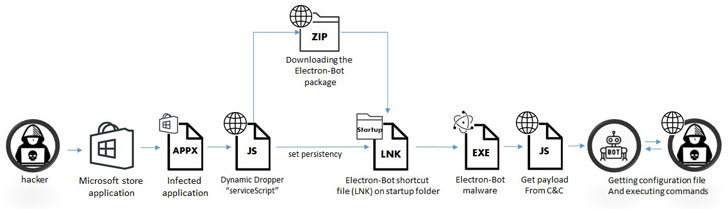
The attack sequence gets triggered when users download one of
the infected applications (e.g., Temple Endless Runner 2) from the
Microsoft store that, when launched, loads the game but also
stealthily drops and installs the next stage dropper via
JavaScript.
Along the way, there are steps to identify potential threat
detection software from companies such as Kaspersky Lab, ESET,
Norton Security, Webroot, Sophos, and F-Secure before the dropper
proceeds to fetch the actual bot malware.
The list of game publishers that pushed the malware-laced apps
is as follows –
- Lupy games
- Crazy 4 games
- Jeuxjeuxkeux games
- Akshi games
- Goo Games
- Bizzon Case
“As the bot’s payload is loaded dynamically at every run time,
the attackers can modify the code and change the bot’s behavior to
high risk,” Marelus noted. “For example, they can initialize
another second stage and drop a new malware such as ransomware or a
RAT. All of this can happen without the victim’s knowledge.”
References
- ^
said
(research.checkpoint.com) - ^
Bleeping
Computer (www.bleepingcomputer.com)
Read more https://thehackernews.com/2022/02/social-media-hijacking-malware.html