Ukraine’s Computer Emergency Response Team (CERT-UA) has warned
of Belarusian state-sponsored hackers targeting its military
personnel and related individuals as part of a phishing campaign
mounted amidst Russia’s military invasion of the country.
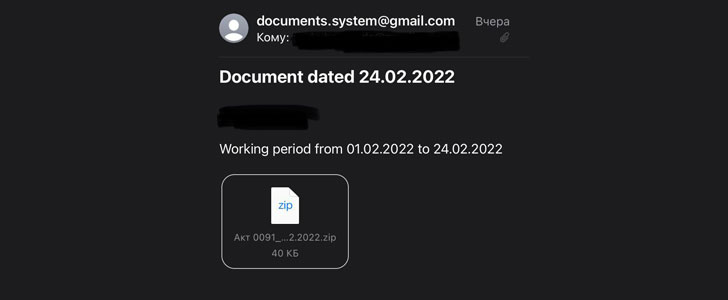
“Mass phishing emails[1]
have recently been observed targeting private ‘i.ua’ and ‘meta.ua’
accounts of Ukrainian military personnel and related individuals,”
the CERT-UA said[2]. “After the account is
compromised, the attackers, by the IMAP protocol, get access to all
the messages.”
Subsequently, the attacks leverage the contact information
stored in the victim’s address book to propagate the phishing
messages to other targets.
The Ukrainian government attributed the activities to a threat
actor tracked as UNC1151, a Minsk-based group whose “members are
officers of the Ministry of Defence of the Republic of Belarus.” In
a follow-up update[3], the agency said the
nation-state group also targets its own citizens, while
simultaneously setting its sights on Russian entities –
- Association of Belarusians of the World (International Social
Union) - Belarusian Music Festival
- Samara Oblasna Public Organization “Russian-Belarusian
Fraternity 2000” - Dzêâslov, a Belarusian literary magazine
- Soviet Belarus (Sovetskaya Belorussiya), a daily newspaper in
Belarus - Employees of the National Academy of the Republic of
Kazakhstan, and - Voice of the Motherland, a local newspaper in Belarus
UNC1151 is the Mandiant-assigned moniker[4] to an uncategorized
threat cluster, which operates with objectives that are aligned
with Belarusian government interests. The hacking group is believed
to have been active since at least 2016.
“UNC1151 has targeted a wide variety of governmental and private
sector entities, with a focus in Ukraine, Lithuania, Latvia,
Poland, and Germany,” Mandiant researchers said in a November 2021
report. “The targeting also includes Belarusian dissidents, media
entities, and journalists.”
The state-backed cyber espionage group has also been linked to
the Ghostwriter disinformation campaign that promulgated anti-NATO
and corruption-themed narratives aimed at Lithuania, Latvia, and
Poland with the likely goal of undermining the governments and
creating tensions in the region.
What’s more, the January defacement attacks[5] of several Ukrainian
government websites with threatening messages is believed to be the
handiwork of UNC1151 as well.
Hacking Groups Take Sides
The development follows a barrage of data wiper[6]
and distributed-denial-of-service (DDoS) attacks against Ukrainian
government agencies, even as various hacking groups and ransomware
syndicates are capitalizing on the chaos to take sides and further
their activities.
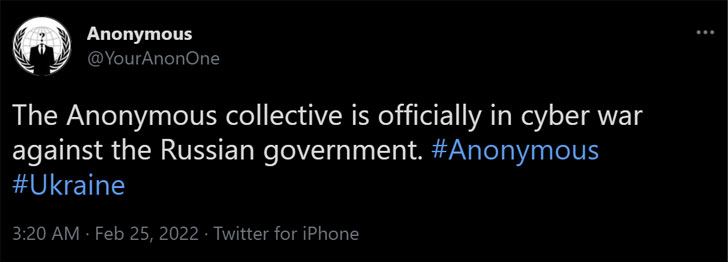
“The Anonymous collective[7]
is officially in cyber war against the Russian government,” the
decentralized hacktivist group tweeted[8], adding[9]
it “leaked the database of the Russian Ministry of Defense
website.”
Another group that has declared its fealty to Ukraine is the
vigilante group known as GhostSec[10] (short for Ghost
Security), which announced[11] it had flooded Russian
military websites with DDoS attacks “in support of the people in
Ukraine.”
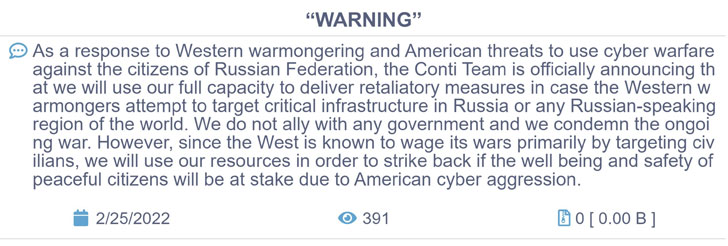
The Conti ransomware cartel, which recently absorbed the
now-shuttered TrickBot[12] trojan, rallied[13] its “full support”
behind the Russian government, threatening to “strike back at the
critical infrastructures of an enemy” should “anybody will decide
to organize a cyber attack or any war activities against
Russia.”
The group, however, later rephrased[14] its statement to state
that “we do not ally with any government and we condemn the ongoing
war.” But Conti Team also maintained that it “will use our full
capacity to deliver retaliatory measures in case the Western
warmongers attempt to target critical infrastructure in Russia or
any Russian-speaking region of the world.”
Other hacking entities to declare allegiance to Russia are the
RedBanditsRU[15] cybercrime group and
the lesser-known CoomingProject[16] ransomware program,
which pledged to “help the Russian government if cyber attacks and
conduct against Russia.”
References
- ^
phishing
emails (twitter.com) - ^
said
(www.facebook.com) - ^
update
(www.facebook.com) - ^
Mandiant-assigned moniker
(www.mandiant.com) - ^
January
defacement attacks (thehackernews.com) - ^
data
wiper (thehackernews.com) - ^
Anonymous collective
(en.wikipedia.org) - ^
tweeted
(twitter.com) - ^
adding
(twitter.com) - ^
GhostSec
(en.wikipedia.org) - ^
announced
(twitter.com) - ^
TrickBot
(thehackernews.com) - ^
rallied
(twitter.com) - ^
rephrased
(twitter.com) - ^
RedBanditsRU
(twitter.com) - ^
CoomingProject
(twitter.com)
Read more https://thehackernews.com/2022/02/russia-ukraine-war-phishing-malware-and.html