An advanced persistent threat (APT) group operating with
objectives aligned with the Chinese government has been linked to
an organized supply chain attack on Taiwan’s financial sector.
The attacks are said to have first commenced at the end of
November 2021, with the intrusions attributed to a threat actor
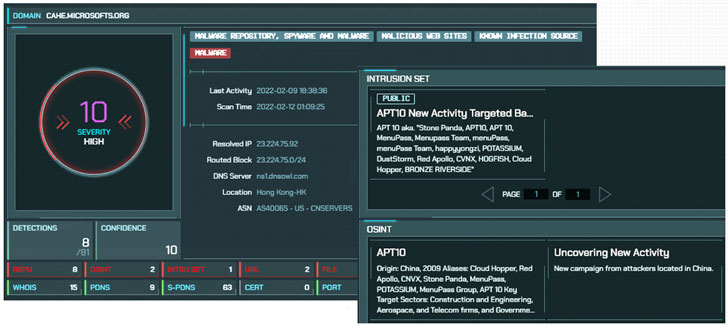
tracked as APT10[1], also known as Stone
Panda, the MenuPass group, and Bronze Riverside, and known to be
active since at least 2009.
The second wave of attacks hit a peak between February 10 and
13, 2022, according to a new report[2]
published by Taiwanese cybersecurity firm CyCraft, which said the
wide-ranging supply chain compromise specifically targeted the
software systems of financial institutions, resulting in “abnormal
cases of placing orders.”
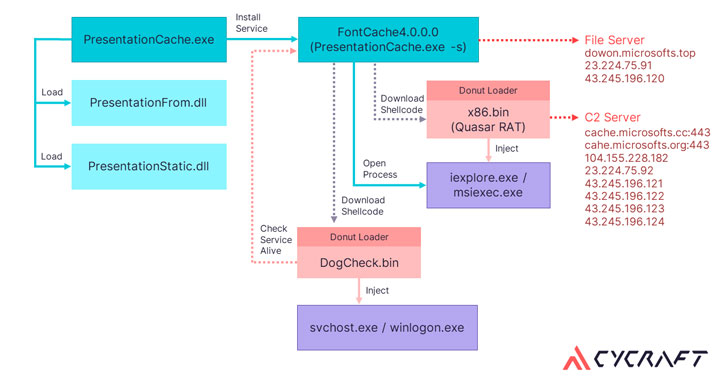
The infiltration activity, codenamed “Operation Cache
Panda,” exploited a vulnerability in the web management
interface of the unnamed securities software that has a market
share of over 80% in Taiwan, using it to deploy a web shell that
acts as a conduit for implanting the Quasar RAT[3]
on the compromised system with the goal of stealing sensitive
information.
Quasar RAT is a publicly available open-source remote access
trojan (RAT) written in .NET. Its features include capturing
screenshots, recording webcam, editing registry, keylogging, and
stealing passwords. In addition, the attacks leveraged a Chinese
cloud file sharing service called wenshushu.cn to download
auxiliary tools.
The disclosure comes as Taiwan’s Parliament, the Executive Yuan,
unveiled draft amendments[4]
to national security laws aimed at combating Chinese economic and
industrial espionage efforts. To that end, unapproved use of
critical national technologies and trade secrets outside of the
country could carry up to a 12-year prison sentence.
Furthermore, individuals and organizations that have been
entrusted or subsidized by the Taiwanese government to conduct
operations involving critical national technologies are expected to
secure prior government approval for any trips to China, failing
which could incur monetary fines of up to NT$10 million
(~US$359,000).
References
- ^
APT10
(malpedia.caad.fkie.fraunhofer.de) - ^
new
report (medium.com) - ^
Quasar
RAT (malpedia.caad.fkie.fraunhofer.de) - ^
draft
amendments (asia.nikkei.com)
Read more https://thehackernews.com/2022/02/chinese-hackers-target-taiwans.html