
Users of the Argo continuous deployment (CD) tool for Kubernetes
are being urged to push through updates after a zero-day
vulnerability was found that could allow an attacker to extract
sensitive information such as passwords and API keys.
The flaw, tagged as CVE-2022-24348[1]
(CVSS score: 7.7), affects all versions and has been addressed in
versions 2.3.0, 2.2.4, and 2.1.9. Cloud security firm Apiiro has
been credited with discovering and reporting the bug on January 30,
2022s.
Continuous deployment, also called continuous delivery, refers
to a process that automatically deploys all code changes to the
testing and/or production environment after they are tested and
merged to a shared repository.
Argo CD is officially used by 191 organizations[2], including Alibaba
Group, BMW Group, Deloitte, Gojek, IBM, Intuit, LexisNexis, Red
Hat, Skyscanner, Swisscom, and Ticketmaster.
The path-traversal vulnerability “allows malicious actors to
load a Kubernetes Helm Chart YAML file[3]
to the vulnerability and ‘hop’ from their application ecosystem to
other applications’ data outside of the user’s scope,” Moshe Zioni,
Apiiro’s VP of security research, said[4].
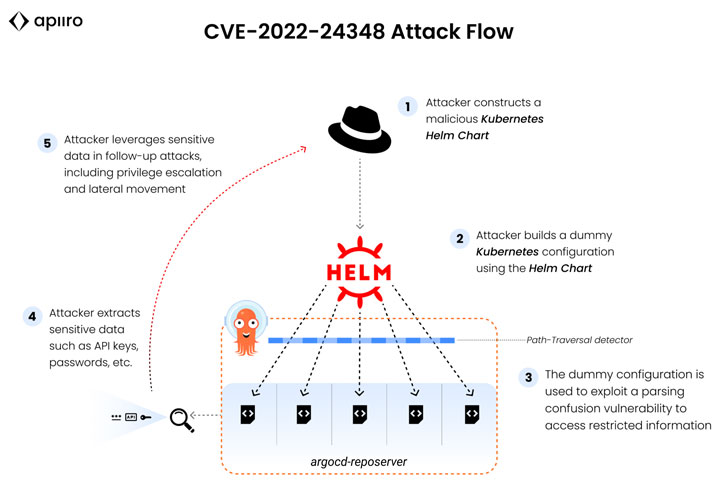
Bad actors can exploit the vulnerability by loading a malicious
Kubernetes Helm Chart YAML file, a package manager which specifies
a collection of Kubernetes resources required to deploy an
application, onto the target system, allowing the retrieval of
confidential information from other apps.
Successful exploitation of the defect could have serious
consequences ranging from privilege escalation and sensitive
information disclosure to lateral movement attacks and exfiltrate
tokens from other applications.
Software supply chain has emerged as a major security threat in
the wake of attacks exploiting SolarWinds[5], Kaseya[6], and Log4j[7]
in recent years. In July 2021, Intezer disclosed[8]
that attackers are taking advantage of misconfigured Argo Workflows
instances to drop cryptominers in Kubernetes (K8s) clusters.
References
- ^
CVE-2022-24348
(github.com) - ^
191
organizations (github.com) - ^
Helm
Chart YAML file (helm.sh) - ^
said
(apiiro.com) - ^
SolarWinds
(thehackernews.com) - ^
Kaseya
(thehackernews.com) - ^
Log4j
(thehackernews.com) - ^
disclosed
(www.intezer.com)
Read more https://thehackernews.com/2022/02/new-argo-cd-bug-could-let-hackers-steal.html