The U.S. Cybersecurity and Infrastructure Security Agency (CISA)
is urging federal agencies to secure their systems against an
actively exploited security vulnerability in Windows that could be
abused to gain elevated permissions on affected hosts.
To that end, the agency has added CVE-2022-21882[1]
(CVSS score: 7.0) to the Known Exploited Vulnerabilities
Catalog[2], necessitating that
Federal Civilian Executive Branch (FCEB) agencies patch all systems
against this vulnerability by February 18, 2022.
“These types of vulnerabilities are a frequent attack vector for
malicious cyber actors of all types and pose significant risk to
the federal enterprise,” CISA said[3]
in an advisory published last week.
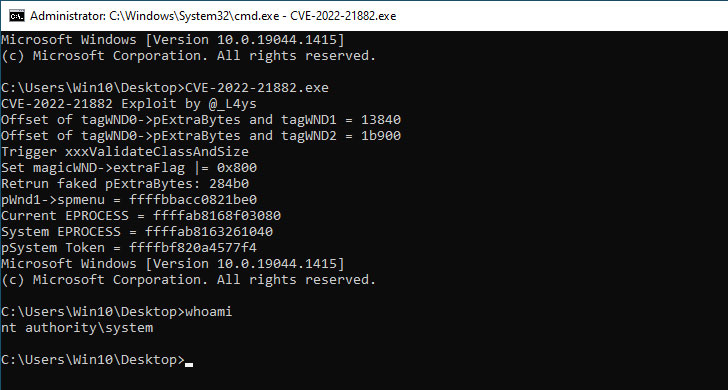
CVE-2022-21882[4], which has been tagged
with an “Exploitation More Likely” exploitability index assessment,
concerns a case of elevation of privilege vulnerability affecting
the Win32k component. The bug was addressed by Microsoft as part of
its January 2022 Patch Tuesday[5]
updates.
“A local, authenticated attacker could gain elevated local
system or administrator privileges through a vulnerability in the
Win32k.sys driver,” the Windows maker said. The flaw impacts
Windows 10, Windows 11, Windows Server 2019, and Windows server
2022.
It’s worth noting that the security vulnerability[6]
is also a bypass[7]
for another escalation of privilege flaw in the same module
(CVE-2021-1732[8], CVSS score: 7.8) that
Microsoft resolved in February 2021[9]
and has since been detected in exploits in the wild[10].
References
- ^
CVE-2022-21882
(msrc.microsoft.com) - ^
Known
Exploited Vulnerabilities Catalog
(www.cisa.gov) - ^
said
(www.cisa.gov) - ^
CVE-2022-21882
(github.com) - ^
Patch
Tuesday (thehackernews.com) - ^
security
vulnerability (googleprojectzero.github.io) - ^
bypass
(googleprojectzero.github.io) - ^
CVE-2021-1732
(msrc.microsoft.com) - ^
February
2021 (thehackernews.com) - ^
exploits in the wild
(www.cisa.gov)
Read more https://thehackernews.com/2022/02/cisa-orders-federal-agencies-to-patch.html