Details have emerged about a previously undocumented malware
campaign undertaken by the Iranian MuddyWater advanced persistent
threat (APT) group targeting Turkish private organizations and
governmental institutions.
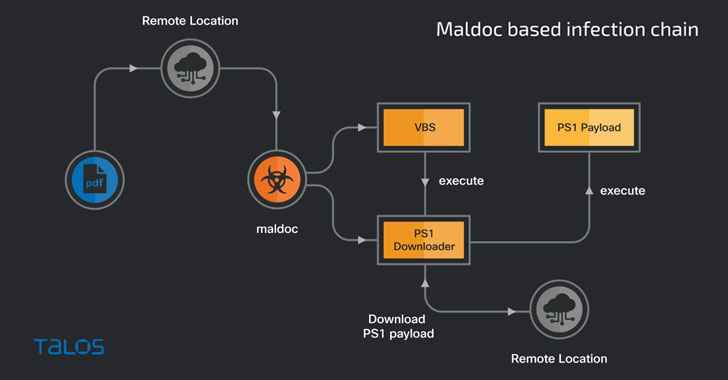
“This campaign utilizes malicious PDFs, XLS files and Windows
executables to deploy malicious PowerShell-based downloaders acting
as initial footholds into the target’s enterprise,” Cisco Talos
researchers Asheer Malhotra and Vitor Ventura said[1]
in a newly published report.
The development[2]
comes as the U.S. Cyber Command, earlier this month, linked the APT[3]
to the Iranian Ministry of Intelligence and Security (MOIS).
The intrusions, which are believed to have been operational as
recently as November 2021, were directed against Turkish government
entities, including the Scientific and Technological Research
Council of Turkey (TÜBİTAK[4]), using weaponized Excel
documents and PDF files hosted on attacker-controlled or
media-sharing websites.
These maldocs masqueraded as legitimate documents from the
Turkish Health and Interior Ministries, with the attacks starting
by executing malicious macros embedded in them to propagate the
infection chain and drop PowerShell scripts to the compromised
system.
A new addition to the group’s arsenal of tactics, techniques and
procedures (TTPs) is the use of canary tokens in the macro code, a
mechanism the researchers suspect is being used to track successful
infection of targets, thwart analysis, and detect if the payload
servers are being blocked at the other end.
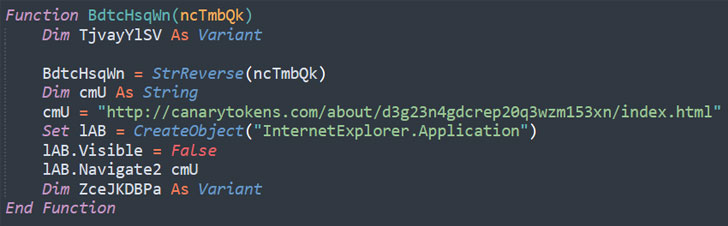
Canary tokens, also known as honeytokens[5], are identifiers
embedded in objects like documents, web pages and emails, which,
when opened, triggers an alert in the form of an HTTP request,
alerting the operator that the object was accessed.
The PowerShell script subsequently downloads and executes the
next payload, also a PowerShell script that resides in the metadata
of the maldoc, which, in turn, acts as the downloader for a third,
unidentified PowerShell code that’s ultimately run on the infected
endpoint.
In a second variant of the attacks observed by Talos, the PDF
documents with embedded links were found pointing to Windows
executables instead of the Excel files, which then instrumented the
infection chain to deploy the PowerShell downloaders.
What’s more, the researchers said they found at least two
different versions of the executable delivered by the adversary
targeting the telecommunications sector in Armenia in June 2021 and
Pakistani entities in August 2021, raising the possibility that
MuddyWater may have engaged in multiple attacks as part of one long
continuous campaign.
The disclosure also follows the release[6]
of a Private Industry Notification (PIN) by the U.S. Federal Bureau
of Investigation (FBI) last week, detailing the malicious cyber
activities of an Iran-based cyber company named Emennet Pasargad,
which was tied to a sophisticated influence campaign[7]
orchestrated to interfere in the 2020 presidential elections.
“These actors are highly capable and motivated to perform their
espionage activities,” the researchers concluded. “With new
techniques such as canary tokens used to track successful infection
of targets, MuddyWater has proven their adaptability and
unwillingness to refrain themselves from attacking other
nations.”
References
- ^
said
(blog.talosintelligence.com) - ^
development
(www.secureworks.com) - ^
linked
the APT (thehackernews.com) - ^
TÜBİTAK
(en.wikipedia.org) - ^
honeytokens
(en.wikipedia.org) - ^
release
(www.cisa.gov) - ^
influence campaign
(thehackernews.com)
Read more https://thehackernews.com/2022/01/researchers-uncover-new-iranian-hacking.html