
2021 was a year peppered by cyberattacks, with numerous data
breaches happening. Not only that, but ransomware has also become a
prominent player in the hackers’ world.
Now, more than ever, it’s important for enterprises to step up
cybersecurity measures. They can do this through several pieces of
technology, such as an open-source security platform like
Wazuh.
Wazuh[1] is a free and open
source security platform that unifies XDR and SIEM capabilities,
which not only enables companies to detect sophisticated threats,
but can also help immensely in preventing data breaches and leaks
from happening. As a result, it can save businesses from costly
fixes that can ultimately end in their closure.
It is also possible to integrate Wazuh with a number of external
services and tools. Some of them are VirusTotal, YARA, Amazon
Macie, Slack, and Fortigate Firewall. Consequently, companies can
improve their security against hackers from penetrating their
networks.
What’s great about Wazuh is that it’s scalable, open source and
free. It can compete with many high-end cybersecurity solutions
that are available for a lot of money. So this can help SMEs
immensely budget-wise.
Read on to find out more on how Wazuh can help with
cybersecurity for businesses.
Security Analytics
Wazuh automatically collects and aggregates security data from
systems running Linux, Windows, macOS, Solaris, AIX, and other
operating systems in the monitored domain, making it an extremely
comprehensive SIEM solution.
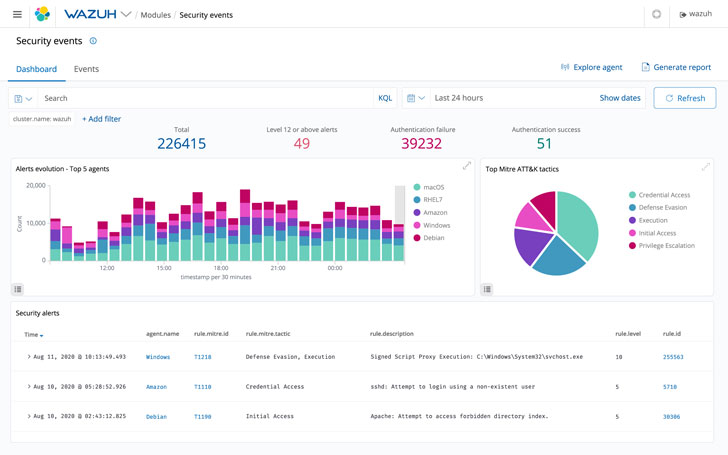
But more importantly, Wazuh also analyzes and correlates data in
order to detect anomalies and intrusions. This type of intelligence
means there’s early threat detection in various environments.
For example, Wazuh can be used in the office, as well as in
cloud environments so remote workers can still reap the benefits of
Wazuh. Improving digital security won’t have to be limited to just
a brick-and-mortar setting.
Intrusion Detection
Wazuh software has multi-platform agents that monitor systems,
detect threats, and trigger automatic responses as needed. More
specifically, they hone in on rootkits and malware, as well as
suspicious anomalies.
In addition, these agents can detect stealth technology like
hidden files, cloaked processes, and unregistered network
listeners.
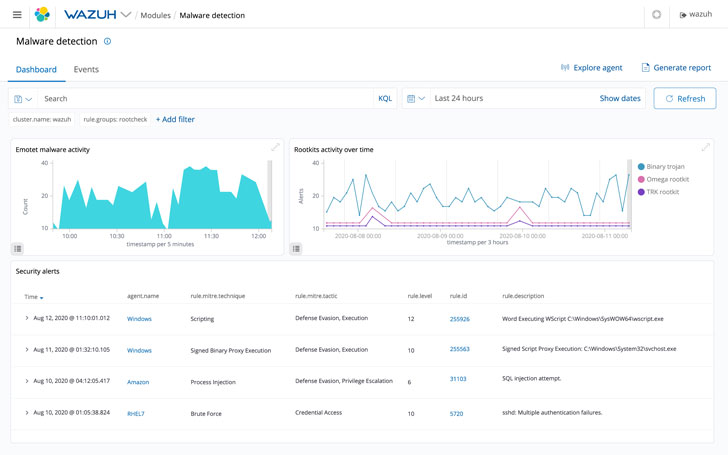
On top of these capabilities for intrusion detection, Wazuh’s
server has a signature-based approach. It analyzes collected log
data and can determine points of compromise by comparing them with
known signatures.
This feature can immediately determine and prevent employees
from downloading and installing malicious applications.
This gives workplaces a safety net. Employee education on
cybersecurity should be the first line of defense, after all.
Vulnerability Detection
Wazuh can also pinpoint where network vulnerabilities are. This
allows enterprises to find their weakest links and plug up holes
before cybercriminals can exploit them first.
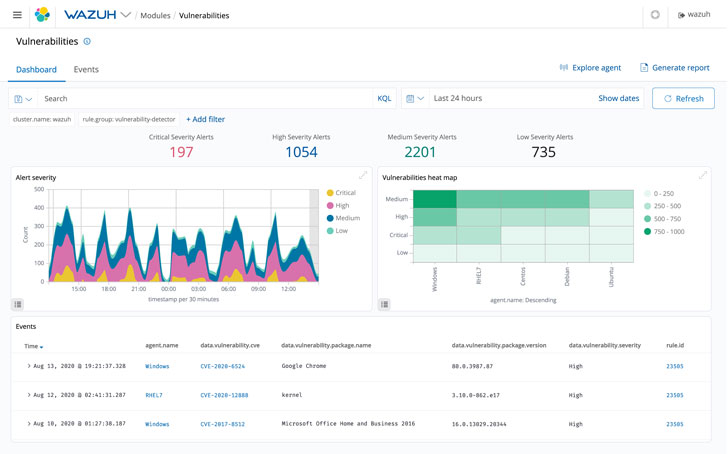
Wazuh agents will pull software inventory data and send it to
their server. Here, it’s compared with continuously updated common
vulnerabilities and exposure (CVE) databases. As a result, these
agents will find and identify any software that’s vulnerable.
In many cases, antivirus software can take care of these
vulnerabilities. These programs release security patches on a
regular basis.
But in rare cases, antivirus developers won’t find
vulnerabilities in time. Or they might not find them at all, which
can leave businesses exposed. Having Wazuh means businesses get an
extra set of eyes to ensure their cybersecurity is airtight.
Log Data Analysis
Not only does Wazuh collect network data and application logs,
but it also securely sends them to a central manager for rule-based
analysis and storage.
This analysis of log data is based on over 3000 different rules
that identify anything that has gone wrong, whether it is an
outside force or user error. For example, the rules in place can
detect application or system errors, policy violations,
misconfigurations, as well as attempted or successful malicious
activity.
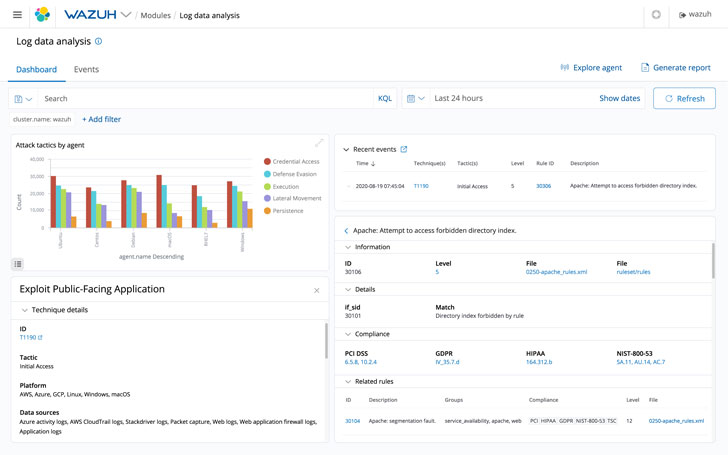
In addition, the log data analysis can pinpoint both attempted
and successful malicious activities. Early detection is key in
keeping networks safe.
Enterprises can learn from attempted malicious activities and
upgrade their cybersecurity accordingly.
And for successful malicious activities, the system can quickly
quarantine infected files. Or they can delete them before they can
do more damage.
Another thing the log data analysis can show is policy
violations. Whether they’re intentional or unintentional, these
violations can be brought to management’s attention. Then, they can
take swift action to rectify the situation.
File Integrity Monitoring
Wazuh’s File integrity monitoring (FIM) feature can be
configured to scan selected files or directories periodically and
alert the user when any changes are detected. Not only does it keep
track of which users create and modify files, but it also tracks
which applications are used and when ownership is changed.
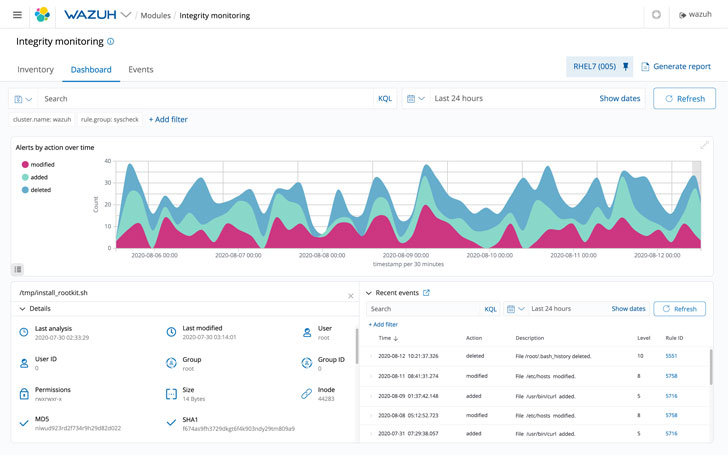
Thanks to the level of detail from file integrity monitoring,
businesses will be able to know exactly when threats come in.
They’ll also identify compromised hosts right away.
For instance, ransomware is now rampant, but Wazuh can help
prevent and detect this threat[2]. Should a hacker attempt
phishing, the security monitoring will pick up on the malicious
files that have snuck in. It will detect new files created, as well
as any original files removed.
Should there be a high number of these instances, the file
integrity monitoring will flag it as a possible ransomware attack.
Note that custom rules should be created for this to happen.
Configuration Assessment
Security compliance is essential to improve an organization’s
security posture and reduce its attack surface. But it can be both
time-consuming and challenging. Fortunately, Wazuh can assist with
it.
Wazuh’s Automated Security Configuration Assessment (SCA) looks
for misconfigurations and helps maintain a standard configuration
across all monitored endpoints.
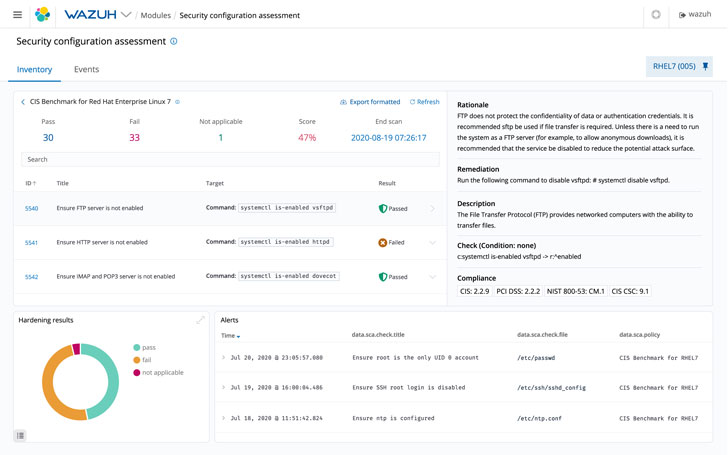
In addition, Wazuh agents also scan applications that are known
to be vulnerable, unpatched or configured insecurely. That way, the
strongest cybersecurity walls are up at all times.
Regulatory Compliance
On the topic of compliance, the regulatory compliance feature
also helps users keep up with standards and regulations. More
importantly, it allows businesses to scale and integrate other
platforms.
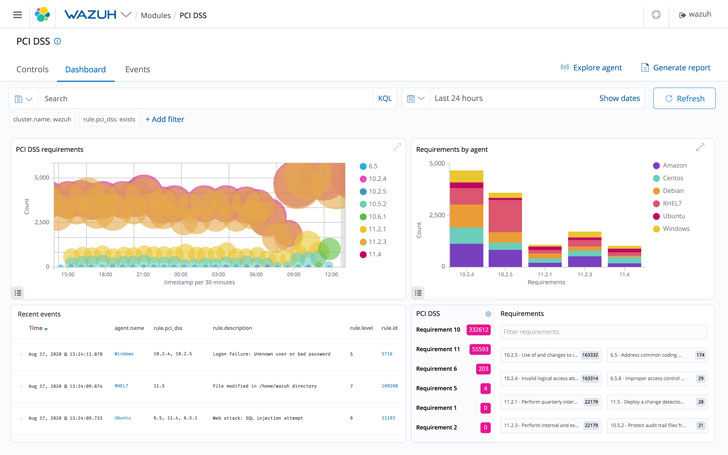
Wazuh generates reports with its web user interface. There are
also multiple dashboards to enable users to manage all platforms
from one place. If the agents notice anything that’s non-compliant,
the users are instantly alerted.
Its ease of use lets many financial companies meet Payment Card
Industry Data Security Standard (PCI DSS) requirements. This
includes payment processing companies, too.
Those in the healthcare industry can have peace of mind knowing
they’re HIPAA-compliant. And for those who deal with European data,
they’ll be
GDPR-compliant[3]
as well.
Incident Response
Incident response is a very useful feature of Wazuh for active
threats. There are out-of-the-box active responses, which means the
user doesn’t have to do anything to set them up. Should the system
detect active threats, countermeasures jump into action right
away.
For example, many hackers use brute-force attacks[4]
to guess username and password combinations. Wazuh will take note
of each failed authentication attempt.
With enough failures, the system will recognize them as part of
a brute-force attack. Because a certain criterion is met (e.g.,
five failed login attempts), it will block that IP address from
further attempts. This means not only can Wazuh pick up on
brute-force attacks, but it can also shut them down.
Additionally, users can use it to run remote commands and system
queries. They can also remotely identify indicators of compromise
(IOCs).
This allows third parties to run live forensics and incident
response tasks. As a result, this opens up opportunities to work
with more professionals who can safeguard company data.
Cloud Security
Today, many workplaces use the cloud to store files. This allows
employees to access them from all over the world, so long as they
have an internet connection.
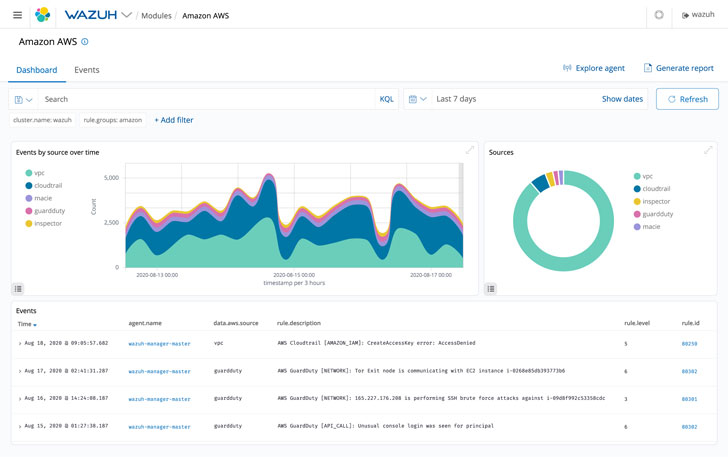
But with this convenience comes a new security concern. Anyone
with an internet connection can possibly hack the cloud and gain
access to sensitive data.
Wazuh uses integration modules, which pull security data from
well-known cloud providers, such as Amazon AWS, Microsoft Azure or
Google Cloud. In addition, it sets rules for a user’s cloud
environment to spot potential weaknesses.
It works similarly to the vulnerability detection function. It
will alert users to intrusion attempts, system anomalies, and
unauthorized user actions.
Containers Security
Wazuh’s containers security feature provides cyber threat
intelligence for Docker hosts, Kubernetes nodes and containers.
Again, it will find system anomalies, vulnerabilities, and
threats.
The agent’s native integration means users don’t have to set up
connections with their Docker hosts and containers. It will keep
collecting and analyzing data. It will also provide users with
continuous monitoring of running containers.
Wazuh is a Must for Enterprises
As the digital world keeps evolving, so do cybercriminals.
Therefore, keeping up with cybersecurity measures and investing in
top-of-the-line intrusion detection is essential.
Wazuh[5] combines all of these
features in a single platform, making it a powerful tool for
analysts as well as a real force multiplier for overburdened IT
staff.
Comparatively to other solutions, Wazuh automatically adds
relevant context to alerts and analyses, enables better
decision-making, and assists in improving compliance and risk
management.
When combined with vulnerability detection, file integrity
monitoring, and configuration assessment, Wazuh can assist
enterprises in staying one step ahead of hackers.
By investing time and resources into this free platform,
businesses can build more layers to their cybersecurity measures.
And in return, they will set themselves up for more secure networks
for years to come.
Wazuh integrations
Below there are several links where you can see how Wazuh can be
integrated with different applications and software and how
capabilities can be extended with these integrations:
References
- ^
Wazuh
(wazuh.com) - ^
prevent
and detect this threat (wazuh.com) - ^
they’ll be GDPR-compliant
(gdpr.eu) - ^
brute-force attacks
(wazuh.com) - ^
Wazuh
(wazuh.com)
Read more https://thehackernews.com/2022/01/how-wazuh-can-improve-digital-security.html