The notorious Lazarus Group[1]
actor has been observed mounting a new campaign that makes use of
the Windows Update service to execute its malicious payload,
expanding the arsenal of living-off-the-land (LotL) techniques
leveraged by the APT group to further its objectives.
The Lazarus Group, also known as APT38[2], Hidden Cobra, Whois
Hacking Team, and Zinc, is the moniker assigned to the North
Korea-based nation-state hacking group that’s been active since at
least 2009. Last year, the threat actor was linked[3]
to an elaborate social engineering campaign[4] targeting security
researchers.
The latest spear-phishing attacks, which Malwarebytes[5]
detected on January 18, originate from weaponized documents with
job-themed lures impersonating the American global security and
aerospace company Lockheed Martin.
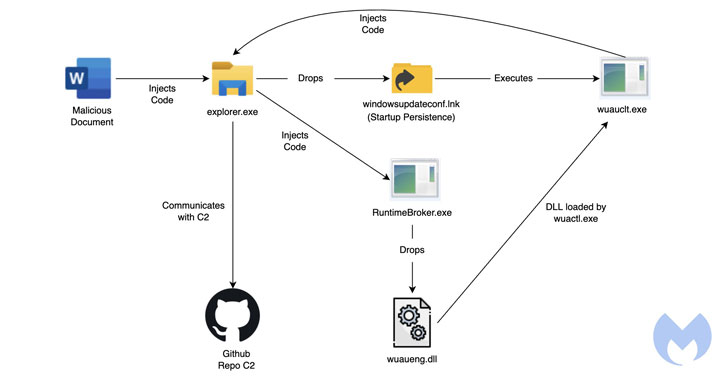
Opening the decoy Microsoft Word file triggers the execution of
a malicious macro embedded within the document that, in turn,
executes a Base64-decoded shellcode to inject a number of malware
components into the explorer.exe process.
In the next phase, one of the loaded binaries, “drops_lnk.dll,”
leverages the Windows Update client to run a second module called
“wuaueng.dll.” “This is an interesting technique used by Lazarus to
run its malicious DLL using the Windows Update Client to bypass
security detection mechanisms,” researchers Ankur Saini and Hossein
Jazi noted.
The cybersecurity firm characterized “wuaueng.dll” as “one of
the most important DLLs in the attack chain,” whose main purpose is
to establish communications with a command-and-control (C2) server
– a GitHub repository hosting malicious modules masquerading as PNG
image files. The GitHub account is said to have been created on
January 17, 2022.
Malwarebytes said that the links to Lazarus Group are based on
several pieces of evidence tying them to past attacks by the same
actor, including infrastructure overlaps, document metadata, and
the use of job opportunities template to single out its
victims.
“Lazarus APT is one of the advanced APT groups that is known to
target the defense industry[6],” the researchers
concluded. “The group keeps updating its toolset to evade security
mechanisms. Even though they have used their old job theme method,
they employed several new techniques to bypass detections.”
References
- ^
Lazarus
Group (thehackernews.com) - ^
APT38
(malpedia.caad.fkie.fraunhofer.de) - ^
linked
(thehackernews.com) - ^
social
engineering campaign (thehackernews.com) - ^
Malwarebytes
(blog.malwarebytes.com) - ^
target
the defense industry (thehackernews.com)
Read more https://thehackernews.com/2022/01/north-korean-hackers-using-windows.html