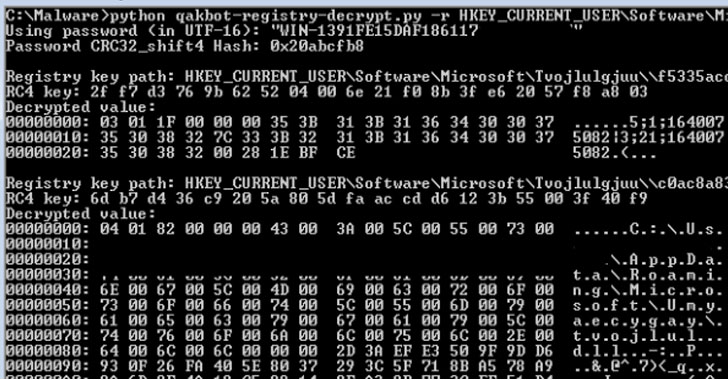
Cybersecurity researchers have decoded the mechanism by which
the versatile Qakbot banking trojan handles the insertion of
encrypted configuration data into the Windows Registry[1].
Qakbot, also known as QBot, QuackBot and Pinkslipbot, has been
observed[2]
in the wild[3]
since 2007. Although mainly fashioned as an information-stealing
malware, Qakbot has since shifted its goals and acquired new
functionality to deliver post-compromise attack platforms such as
Cobalt Strike Beacon, with the final objective of loading
ransomware on infected machines.
“It has been continually developed, with new capabilities
introduced such as lateral movement, the ability to exfiltrate
email and browser data, and to install additional malware,”
Trustwave researchers Lloyd Macrohon and Rodel Mendrez said in a
report shared with The Hacker News.
In recent months, phishing campaigns have culminated in the
distribution of a new loader[4]
called SQUIRRELWAFFLE[5], which acts as a channel
to retrieve final-stage payloads such as Cobalt Strike and
QBot.
Newer versions of Qakbot have also gained the ability to hijack
email and browser data as well as insert encrypted configuration
information pertaining to the malware into the registry as opposed
to writing them to a file on disk as part of its attempts to leave
no trace of the infection.
“While QakBot is not going fully fileless, its new tactics will
surely lower its detection,” Hornetsecurity researchers pointed out[6]
in December 2020.
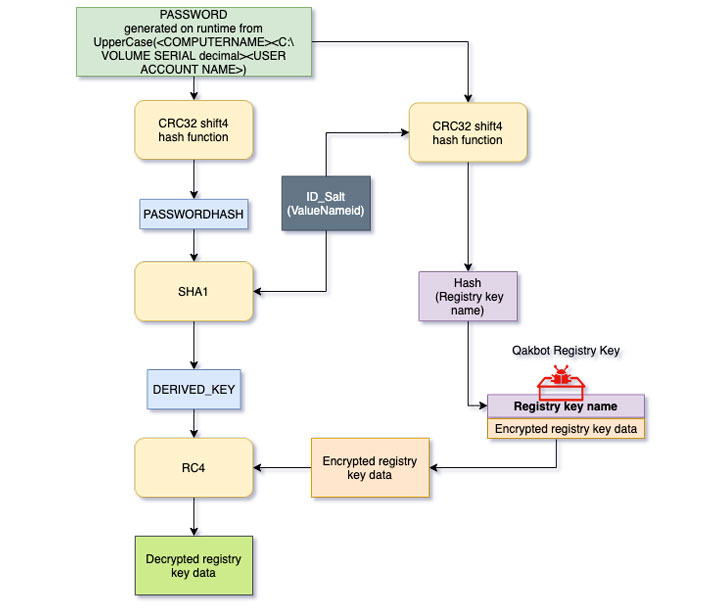
Trustwave’s analysis into the malware aims to reverse engineer
this process and decrypt the configuration stored in the registry
key, with the cybersecurity company noting that the key used to
encrypt the registry key value data is derived from a combination
of computer name, volume serial number, and the user account name,
which is then hashed and salted along with a one-byte identifier
(ID).
“The SHA1[7]
hash result will be used as a derived key to decrypt the registry
key value data respective to the ID using the RC4[8]
algorithm,” the researchers said, in addition to making available a
Python-based decryptor utility[9] that can be used to
extract the configuration from the registry.
References
- ^
Windows
Registry (en.wikipedia.org) - ^
observed
(securelist.com) - ^
in the
wild (thehackernews.com) - ^
new
loader (thehackernews.com) - ^
SQUIRRELWAFFLE
(thehackernews.com) - ^
pointed
out (www.hornetsecurity.com) - ^
SHA1
(en.wikipedia.org) - ^
RC4
(en.wikipedia.org) - ^
Python-based decryptor utility
(github.com)
Read more https://thehackernews.com/2022/01/researchers-decrypted-qakbot-banking.html