It is a time when many are thinking of their families and loved
ones, time off work, and gift-giving – the holidays. However, while
many have their minds outside the realm of work during the holiday
season, often, this is when attackers plan their most sinister
attacks.
So how can you take precautions to protect your organization
during these times?
Why holidays put your company at risk of cyberattack
Attackers today do not have a soft spot for businesses and give
companies a break at any time of the year, especially not during
holidays. On the contrary, any time of the year where companies may
be less prepared to fend off a cyberattack is an opportunity for
successful compromise. As a result, the holidays put your company
at a higher risk of cyberattack.
Most end-users do not think about cybersecurity when surfing the
web or receiving emails with holiday deals during the season. As a
result, many let their guard down to a certain degree and become
preoccupied and distracted more than usual. Increased distraction
from the end-user perspective and less scrutiny of emails and
websites where holiday discounts and offers may be displayed can
provide the perfect opportunity for attackers using phishing scams
or malicious advertisements.
Additionally, IT operations and SecOps teams may be
short-staffed with staff out on vacation during the holidays. It
creates a situation of increased risk to business-critical data
with potentially fewer resources to help mitigate risks and
breaches if they happen.
Earlier this year, the FBI and Cybersecurity & Infrastructure
Security Agency released a general alert for increased vigilance
for ransomware attacks during holidays. You can read the warning
here: Ransomware Awareness for Holidays and
Weekends | CISA[1]. In part, it states:
“The Federal Bureau of Investigation (FBI) and the
Cybersecurity and Infrastructure Security Agency (CISA) have
observed an increase in highly impactful ransomware attacks
occurring on holidays and weekends—when offices are normally
closed—in the United States, as recently as the Fourth of July
holiday in 2021.”
With upcoming holidays in the U.S. and worldwide, organizations
must remain vigilant and on guard to protect against many forms of
attack. Let’s look at the following common cybersecurity risks
during this holiday season:
- Ransomware
- Phishing email
- Data breach
- Distributed Denial of Service (DDoS)
- Breached passwords
1 – Ransomware
Ransomware is by far one of the most sinister threats to
organizations and their data today. With the increased threat of
successful phishing attacks and visits to malicious websites, the
chances of your business getting infected with ransomware
drastically increase.
Threat actors may entice users to click on a malicious link in a
phishing email or perform a drive-by attack using malicious web
code on a hijacked website. Either way, it can be a gateway for
ransomware infection. Note the following ransomware attacks over a
holiday:
To protect against ransomware, organizations must put the
appropriate security measures in place, including:
- Phishing email filtering
- Strong password policies and breached password protection
- Least privilege access
- Micro-segmentation
- Application whitelisting
- Other security measures
Is ransomware costly to businesses? According to the IBM Cost of a Data
Breach 2021 report[2], ransomware is highly
costly to your business:
Ransomware attacks cost an average of $4.62 million, more
expensive than the average data breach ($4.24 million). These costs
included escalation, notification, lost business, and response
costs, but did not include the cost of the ransom. Malicious
attacks that destroyed data in destructive wiper-style attacks cost
an average of $4.69 million. The percentage of companies where
ransomware was a factor in the breach was 7.8%.
2 – Phishing email
One of the easy ways that attackers can compromise environments
is by using phishing emails. Phishing emails masquerade as
communications from legitimate companies. Attackers have become
proficient in making phishing emails appear legitimate, from the
logos, wording, images, and other styling associated with the
email.
Without appropriate security protections in place, an end-user
simply must click on the malicious link, and the damage begins. For
example, suppose there are no zero-trust or micro-segmentation
boundaries in place. In that case, the ransomware can freely crawl
across the network and infect anything on which the user has
“write” or “modify” permissions.
During the holiday season, end-users are generally “click-happy”
and may not scrutinize emails and other communications as closely.
As a result, attackers may use the flood of email communications to
infiltrate the organization’s perimeter with a phishing attack.
Again, cybersecurity basics come into play to protect against
phishing emails, like the protections listed for ransomware:
- Phishing email filtering
- End-user cybersecurity training
- Disallowed attachments
3 – Data breach
Data breaches are a critical cybersecurity threat for
organizations worldwide. The implications and financial fall-out
from a data breach event can be tremendous. The IBM Cost of a Data
Breach Report 2021 cites[3]:
Data breach costs increased significantly year-over year from
the 2020 report to the 2021 report, increasing from $3.86 million
in 2020 to $4.24 million in 2021. The increase of $0.38 million
($380,000) represents a 9.8% increase. This compares to a decrease
of 1.5% from the 2019 to 2020 report year. The cost of a data
breach has increase by 11.9% since 2015.
Data breaches can occur intentionally, unintentionally, or due
to malicious cyberattacks. For example, an employee may
accidentally share data they shouldn’t share or do this
intentionally. In the holiday season, employees are more distracted
with holiday plans or other activities and, by extension, more apt
to expose data. Additionally, with the increased ransomware threat,
the list of modern ransomware variants threatening data leaks is
growing.
It includes:
- AKO
- AVADDON
- BABUK LOCKER
- CLOP
- CONTI
- CUBA
- DARKSIDE
- DOPPELPAYMER
- EGREGOR
- EVEREST
- LOCKBIT
- MAZE
- MESPINOZA
- MOUNT LOCKER
- NEFILIM
- NEMTY
- REVIL
4 – Distributed Denial of Service (DDoS) attacks
Another threat for businesses around the holidays is Distributed
Denial of Service (DDoS) attacks. According to the statistics, the
volume of Distributed Denial of Service (DDoS) attacks increases
around the holidays.
In addition, since the beginning of the global pandemic in 2020,
online shopping and retail have increased dramatically as more
individuals prefer online shopping.
Attackers know the damage caused by DDoS attacks now is more
costly to businesses, especially around the lucrative holiday
season.
According to current forecasts, DDoS attacks will reach a record
11 million by the end of 2021. Knowing this, organizations must
design their network mitigations and server technologies with the
ability to withstand more significant DDoS attacks.
5 – Breached passwords
One of the most common ways attackers attempt to compromise
environments is using compromised credentials. Obtaining
compromised credentials is an easy, minimal effort attack vector
that can lead to tremendous damage to business-critical data.
As mentioned, employees are more distracted and prove to be
easier targets around the holidays. Phishing emails, aside from
launching a ransomware attack, can be used to harvest legitimate
credentials. A growing business on the dark web is Initial
Access Brokers. The Initial Access Broker[4]
provides criminals with legitimate and verified user accounts for a
price. It allows attackers to purchase credentials on the dark web,
so the hard work of getting access to the environment is already
complete.
According to the IBM Cost of a Data Breach Report 2021,
compromised credentials were the most common initial attack vector,
accounting for 20% of breaches. In addition, compromised
credentials are among the costliest and lead to a longer data
breach lifecycle than other types of data breaches as they are more
challenging to detect. To combat this threat, organizations must
bolster their password policies and implement adequate breached
password protection.
Bolster password policy and stop breached accounts
Increasing the security of Active Directory passwords and
implementing breached password protection are critical to
bolstering cybersecurity posture during the holidays.
Unfortunately, native Active Directory password policies lack
modern features to protect user accounts from weak passwords,
incremental passwords, and significantly breached passwords.
Specops Password Policy[5]
helps to overcome these challenges. Note the following
features.
- It protects against the use of weak Active Directory
passwords - It protects against the use of incremental passwords
- It can implement length-based aging
- It provides continuous breached password protection
- Specops monitor brute force attempts on dangerous ports, such
as RDP, for the LIVE password’s attackers are using - It helps to defend your organization against credential-based
ransomware attacks by alerting businesses to passwords in use found
in breached password lists
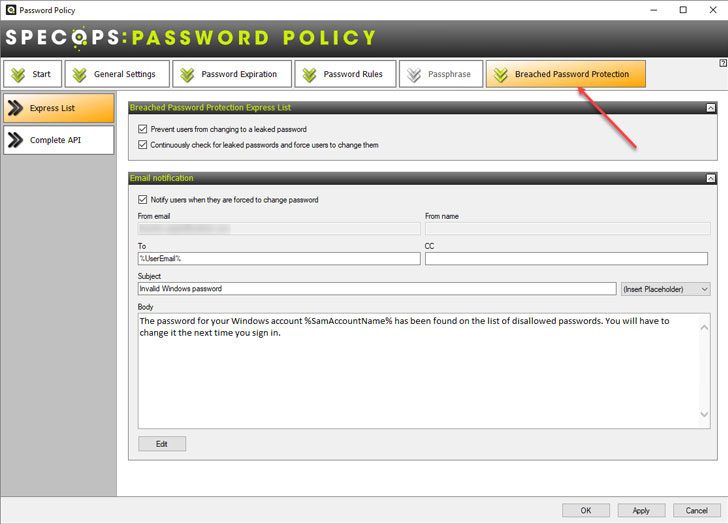 |
| Specops Breached Password Protection |
In addition, Specops Password Policy provides the following
benefits:
- Easy implementation of multiple password dictionary lists
- Over 2 billion breached passwords and growing
- LIVE breached password account data
- Find and remove breached passwords in your Active Directory
environment - Informative client messaging
- Real-time, dynamic feedback to end-users at password
change - Customize password expiration based on password length
- Block common information from use in passwords, including
usernames, display names, specific words, consecutive characters,
incremental passwords, and reusing a part of the current
password - Granular, GPO-driven targeting for any GPO level, computer,
user, or group population - Passphrase support
- Supports over 25 languages
- Use Regular Expressions to customize password filtering
further
Learn more about the password protection provided by Specops
Password Policy and start a free trial[6].
References
- ^
Ransomware Awareness for Holidays and
Weekends | CISA (us-cert.cisa.gov) - ^
IBM Cost
of a Data Breach 2021 report (www.ibm.com) - ^
IBM Cost
of a Data Breach Report 2021 cites
(www.ibm.com) - ^
Initial
Access Broker (www.forbes.com) - ^
Specops
Password Policy (specopssoft.com) - ^
start a
free trial (specopssoft.com)
Read more https://thehackernews.com/2021/12/why-holidays-put-your-company-at-risk.html