
At least 300,000 IP addresses associated with MikroTik devices
have been found vulnerable to multiple remotely exploitable
security vulnerabilities that have since been patched by the
popular supplier of routers and wireless ISP devices.
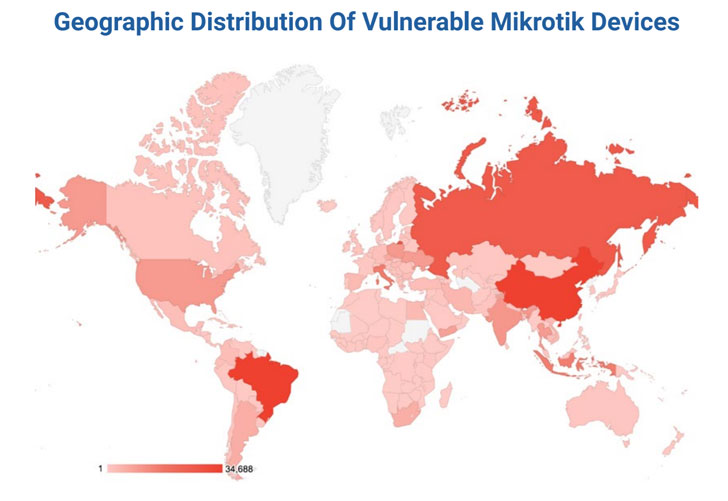
The most affected devices are located in China, Brazil, Russia,
Italy, Indonesia, with the U.S. coming in at number eight,
cybersecurity firm Eclypsium said in a report shared with The
Hacker News.
“These devices are both powerful, [and] often highly
vulnerable,” the researchers noted[1]. “This has made MikroTik
devices a favorite among threat actors who have commandeered the
devices for everything from DDoS attacks, command-and-control (aka
‘C2’), traffic tunneling, and more.”
MikroTik devices are an enticing target not least because there
are more than two million of them deployed worldwide, posing a huge
attack surface that can be leveraged by threat actors to mount an
array of intrusions.
Indeed, earlier this September, reports emerged of a new botnet
named Mēris[2]
that staged a record-breaking distributed denial-of-service (DDoS)
attack against Russian internet company Yandex by using network
devices from Mikrotik as an attack vector by exploiting a
now-addressed security vulnerability in the operating system
(CVE-2018-14847[3]).
The list of four vulnerabilities discovered over the last three
years and which could enable full takeover of MikroTik devices is
below –
- CVE-2019-3977[4] (CVSS score: 7.5) –
MikroTik RouterOS insufficient validation of upgrade package’s
origin, allowing a reset of all usernames and passwords - CVE-2019-3978[5] (CVSS score: 7.5) –
MikroTik RouterOS insufficient protections of a critical resource,
leading to cache poisoning - CVE-2018-14847[6] (CVSS score: 9.1) –
MikroTik RouterOS directory traversal vulnerability in the WinBox
interface - CVE-2018-7445[7] (CVSS score: 9.8) –
MikroTik RouterOS SMB buffer overflow vulnerability
In addition, Eclypsium researchers said they found 20,000
exposed MikroTik devices that injected cryptocurrency mining
scripts into web pages that users visited.
“The ability for compromised routers to inject malicious
content, tunnel, copy, or reroute traffic can be used in a variety
of highly damaging ways,” the researchers said. “DNS poisoning
could redirect a remote worker’s connection to a malicious website
or introduce a machine-the-middle.”

“An attacker could use well-known techniques and tools to
potentially capture sensitive information such as stealing MFA[8]
credentials from a remote user using SMS over WiFi. As with
previous attacks, enterprise traffic could be tunneled to another
location or malicious content injected into valid traffic,” the
researchers added.
MikroTik routers are far from the only devices to have been
co-opted into a botnet. Researchers from Fortinet this week
disclosed how the Moobot botnet[9]
is leveraging a known remote code execution (RCE) vulnerability in
Hikvision video surveillance products (CVE-2021-36260[10]) to grow its network,
and use the compromised devices to launch distributed
denial-of-service (DDoS) attacks.
References
- ^
noted
(eclypsium.com) - ^
Mēris
(thehackernews.com) - ^
CVE-2018-14847
(blog.mikrotik.com) - ^
CVE-2019-3977
(nvd.nist.gov) - ^
CVE-2019-3978
(nvd.nist.gov) - ^
CVE-2018-14847
(nvd.nist.gov) - ^
CVE-2018-7445
(nvd.nist.gov) - ^
MFA
(en.wikipedia.org) - ^
Moobot
botnet (www.fortinet.com) - ^
CVE-2021-36260
(nvd.nist.gov)
Read more https://thehackernews.com/2021/12/over-300000-mikrotik-devices-found.html