Researchers from Qihoo 360’s Netlab security team have released
details of a new evolving botnet called “Abcbot[1]” that has been observed
in the wild with worm-like propagation features to infect Linux
systems and launch distributed denial-of-service (DDoS) attacks
against targets.
While the earliest version of the botnet dates back to July
2021, new variants observed as recently as October 30 have been
equipped with additional updates to strike Linux web servers with
weak passwords and are susceptible to N-day vulnerabilities,
including a custom implementation of DDoS functionality, indicating
that the malware is under continuous development.
Netlab’s findings also build on a report from Trend Micro early
last month, which publicized[2]
attacks targeting Huawei Cloud with cryptocurrency-mining and
cryptojacking malware. The intrusions were also notable for the
fact that the malicious shell scripts specifically disabled a
process designed to monitor and scan the servers for security
issues as well as reset users’ passwords to the Elastic cloud
service.
Now according to the Chinese internet security company, these
shell scripts are being used to spread Abcbot. A total of six
versions of the botnet have been observed to date.
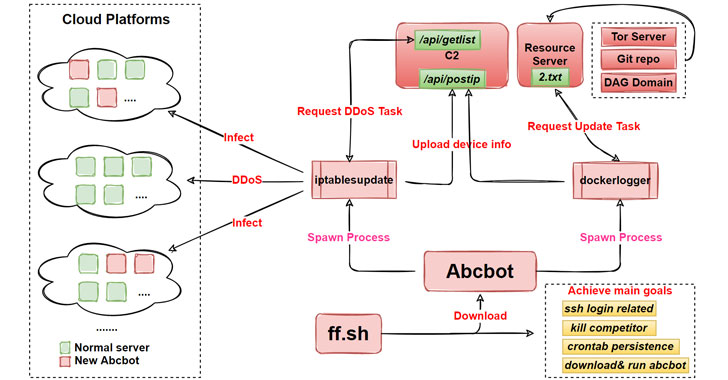
Once installed on a compromised host, the malware triggers the
execution of a series of steps that results in the infected device
being repurposed as a web server, in addition to reporting the
system information to a command-and-control (C2) server, spreading
the malware to new devices by scanning for open ports, and
self-updating itself as and when new features are made available by
its operators.
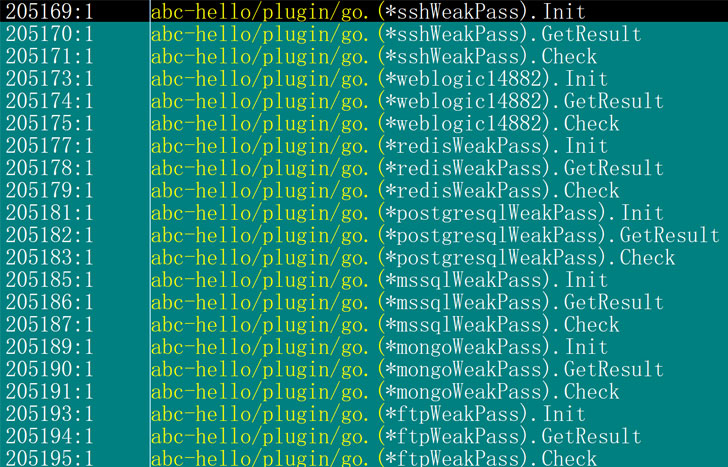
“Interesting thing is that the sample [updated] on October 21
uses the open-source ATK Rootkit[3]
to implement the DDoS function,” a mechanism which the researchers
said “requires Abcbot to download the source code, compile, and
load the rootkit module before performing [a] DDoS attack.”
“This process requires too many steps, and any step that is
faulty will result in the failure of the DDoS function,” the
researchers noted, leading the adversary to replace the
off-the-shelf code with a custom attack module in a subsequent
version released on October 30 that completely abandons the ATK
rootkit.
The findings come a little over a week after the Netlab security
team disclosed details of a “Pink[4]” botnet that’s believed
to have infected over 1.6 million devices primarily located in
China with the goal of launching DDoS attacks and inserting
advertisements into HTTP websites visited by unsuspecting users. In
a related development, AT&T Alien Labs took the wraps off a new
Golang malware dubbed “BotenaGo[5]” that has been
discovered using over thirty exploits to attack millions of routers
and IoT devices potentially.
“The update process in these six months is not so much a
continuous upgrade of features as a trade-off between different
technologies,” the researchers concluded. “Abcbot is slowly moving
from infancy to maturity. We do not consider this stage to be the
final form, there are obviously many areas of improvement or
features to be developed at this stage.”
References
- ^
Abcbot
(blog.netlab.360.com) - ^
publicized
(www.trendmicro.com) - ^
ATK
Rootkit (github.com) - ^
Pink
(thehackernews.com) - ^
BotenaGo
(cybersecurity.att.com)
Read more https://thehackernews.com/2021/11/abcbot-new-evolving-wormable-botnet.html