Threat actors are increasingly banking on the technique of
HTML smuggling[1]
in phishing campaigns as a means to gain initial access and deploy
an array of threats, including banking malware, remote
administration trojans (RATs), and ransomware payloads.
Microsoft 365 Defender Threat Intelligence Team, in a new report
published Thursday, disclosed that it identified infiltrations
distributing the Mekotio[2]
banking Trojan, backdoors such as AsyncRAT[3]
and NjRAT[4], and the infamous
TrickBot[5]
malware. The multi-staged attacks — dubbed ISOMorph[6]
— were also publicly documented by Menlo Security in July 2021.
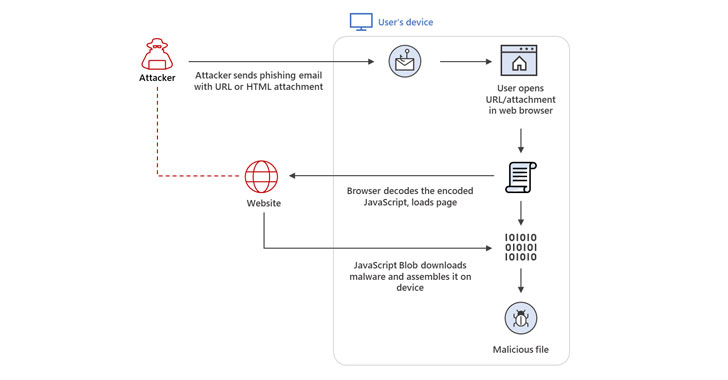
HTML smuggling is an approach that allows an attacker to
“smuggle” first-stage droppers, often encoded malicious scripts
embedded within specially-crafted HTML attachment or web pages, on
a victim machine by taking advantage of basic features in HTML5 and
JavaScript rather than exploiting a vulnerability or a design flaw
in modern web browsers.
By doing so, it enables the threat actor to construct the
payloads programmatically on the HTML page using JavaScript,
instead of having to make an HTTP request to fetch a resource on a
web server, while also simultaneously evading perimeter security
solutions. The HTML droppers are then used to fetch the primary
malware to be executed on the compromised endpoints.
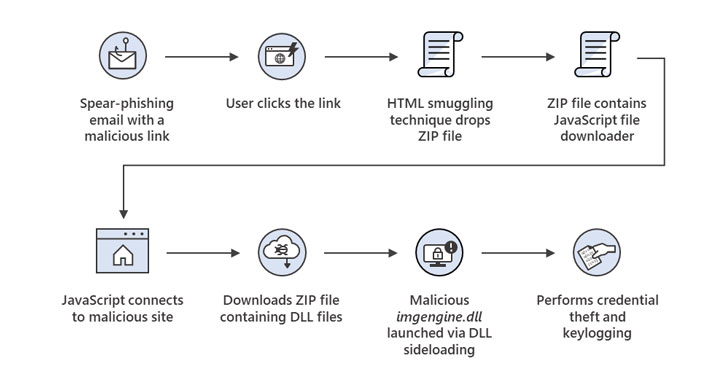 |
| Threat behavior observed in the Mekotio campaign |
“When a target user opens the HTML in their web browser, the
browser decodes the malicious script, which, in turn, assembles the
payload on the host device,” the researchers said[7]. “Thus, instead of
having a malicious executable pass directly through a network, the
attacker builds the malware locally behind a firewall.”
HTTP Smuggling’s ability to bypass web proxies and email
gateways have made it a lucrative method among state-sponsored
actors and cybercriminal groups to deliver malware in real-world
attacks, Microsoft noted.
Nobelium, the threat group behind the SolarWinds supply chain
hack, was found[8]
leveraging this very tactic to deliver a Cobalt Strike Beacon as
part of a sophisticated email-based attack aimed at government
agencies, think tanks, consultants, and non-governmental
organizations located across 24 countries, including the U.S.,
earlier this May.
Beyond espionage operations, HTML smuggling has also been
embraced for banking malware attacks involving the Mekotio trojan,
what with the adversaries sending spam emails containing a
malicious link that, when clicked, triggers the download of a ZIP
file, which, in turn, contains a JavaScript file downloader to
retrieve binaries capable of credential theft and keylogging.
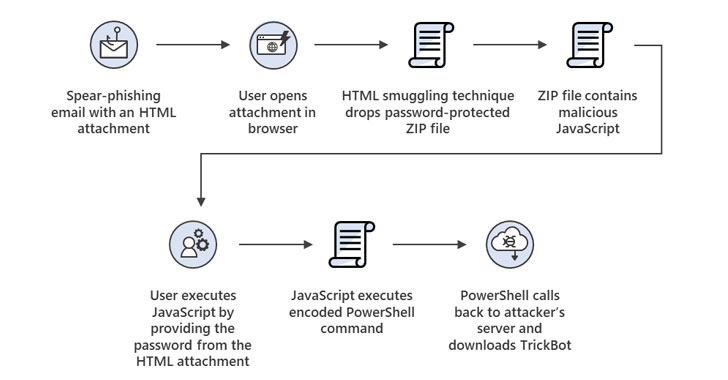 |
| HTML smuggling attack chain in the Trickbot spear-phishing campaign |
But in a sign that other actors are taking notice and
incorporating HTML smuggling in their arsenal, a September email
campaign undertaken by DEV-0193[9]
was uncovered, abusing the same method to deliver TrickBot. The
attacks entail a malicious HTML attachment, which, when opened on a
web browser, creates a password-protected JavaScript file on the
recipient’s system, prompting the victim to supply the password
from the original HTML attachment.
Doing so initiates the execution of the JavaScript code, which
subsequently launches a Base64-encoded PowerShell command to
contact an attacker-controlled server to download the TrickBot
malware, ultimately paving the way for follow-on ransomware
attacks.
“The surge in the use of HTML smuggling in email campaigns is
another example of how attackers keep refining specific components
of their attacks by integrating highly evasive techniques,”
Microsoft noted. “Such adoption shows how tactics, techniques, and
procedures (TTPs) trickle down from cybercrime gangs to malicious
threat actors and vice versa. It also reinforces the current state
of the underground economy, where such TTPs get commoditized when
deemed effective.”
References
- ^
HTML
smuggling (twitter.com) - ^
Mekotio
(thehackernews.com) - ^
AsyncRAT
(malpedia.caad.fkie.fraunhofer.de) - ^
NjRAT
(malpedia.caad.fkie.fraunhofer.de) - ^
TrickBot
(thehackernews.com) - ^
ISOMorph
(www.menlosecurity.com) - ^
said
(www.microsoft.com) - ^
found
(thehackernews.com) - ^
DEV-0193
(thehackernews.com)
Read more https://thehackernews.com/2021/11/hackers-increasingly-using-html.html