
Google researchers on Thursday disclosed that it found a
watering hole attack in late August exploiting a now-parched
zero-day in macOS operating system and targeting Hong Kong websites
related to a media outlet and a prominent pro-democracy labor and
political group to deliver a never-before-seen backdoor on
compromised machines.
“Based on our findings, we believe this threat actor to be a
well-resourced group, likely state backed, with access to their own
software engineering team based on the quality of the payload
code,” Google Threat Analysis Group (TAG) researcher Erye Hernandez
said[1]
in a report.
Tracked as CVE-2021-30869[2]
(CVSS score: 7.8), the security shortcoming concerns a type
confusion vulnerability affecting the XNU[3]
kernel component that could cause a malicious application to
execute arbitrary code with the highest privileges. Apple addressed
the issue on September 23.

The attacks observed by TAG involved an exploit chain that
strung together CVE-2021-1789[4], a remote code execution
bug in WebKit that was fixed in February 2021, and the
aforementioned CVE-2021-30869 to break out of the Safari sandbox,
elevate privileges, and download and execute a second stage payload
dubbed “MACMA” from a remote server.
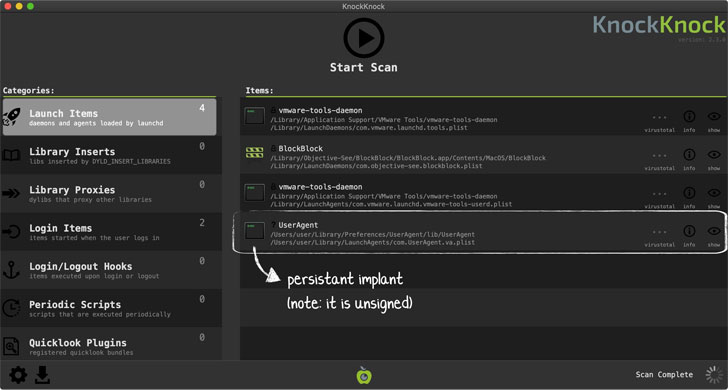
This previously undocumented malware, a fully-featured implant,
is marked by “extensive software engineering” with capabilities to
record audio and keystrokes, fingerprint the device, capture the
screen, download and upload arbitrary files, and execute malicious
terminal commands, Google TAG said. Samples[5]
of the backdoor[6]
uploaded to VirusTotal reveal that none of the anti-malware engines
currently detect the files as malicious.
According to security researcher Patrick Wardle[7], a 2019 variant of MACMA
masquerades as Adobe Flash Player, with the binary displaying an
error message in Chinese language post-installation, suggesting
that “the malware is geared towards Chinese users” and that “this
version of the malware is designed to be deployed via socially
engineering methods.” The 2021 version, on the other hand, is
designed for remote exploitation.
The websites, which contained malicious code to serve exploits
from an attacker-controlled server, also acted as a watering hole
to target iOS users, albeit using a different exploit chain
delivered to the victims’ browser. Google TAG said it was only able
to recover a part of the infection flow, where a type confusion bug
(CVE-2019-8506[8]) was used to gain code
execution in Safari.
Additional indicators of compromise (IoCs) associated with the
campaign can be accessed here[9].
References
- ^
said
(blog.google) - ^
CVE-2021-30869
(thehackernews.com) - ^
XNU
(en.wikipedia.org) - ^
CVE-2021-1789
(support.apple.com) - ^
Samples
(www.virustotal.com) - ^
backdoor
(www.virustotal.com) - ^
Patrick
Wardle (objective-see.com) - ^
CVE-2019-8506
(nvd.nist.gov) - ^
here
(blog.google)
Read more https://thehackernews.com/2021/11/hackers-exploit-macos-zero-day-to-hack.html