
A new cyber mercenary hacker-for-hire group dubbed “Void
Balaur” has been linked to a string of cyberespionage and data
theft activities targeting thousands of entities as well as human
rights activists, politicians, and government officials around the
world at least since 2015 for financial gain while lurking in the
shadows.
Named after a many-headed dragon[1]
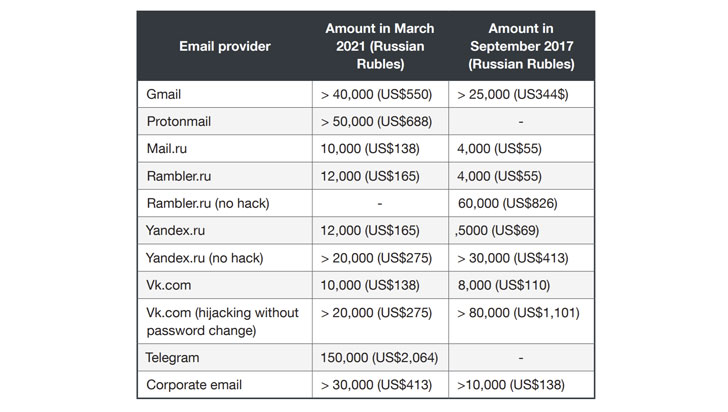
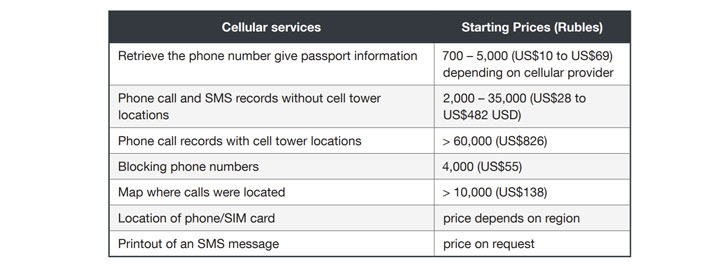
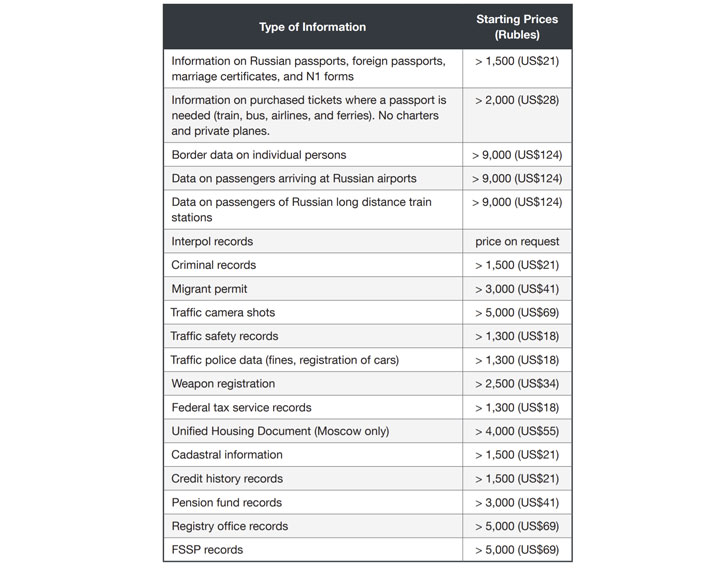
from Romanian folklore, the adversary has been unmasked advertising
its services in Russian-speaking underground forums dating all the
way back to 2017 and selling troves of sensitive information such
as cell tower phone logs, passenger flight records, credit reports,
banking data, SMS messages, and passport details. The threat actor
calls itself “Rockethack.”
“This hacker-for-hire group does not operate out of a physical
building, nor does it have a shiny prospectus that describes its
services,” Trend Micro researcher Feike Hacquebord said[2]
in a newly published profile of the collective.
“The group does not try to wriggle out of a difficult position
by justifying its business, nor is it involved in lawsuits against
anybody attempting to report on their activities. Instead, this
group is quite open about what it does: breaking into email
accounts and social media accounts for money,” Hacquebord
added.
Besides gaining near unanimous positive reviews on the forums
for its ability to offer quality information, Void Balaur is also
believed to have focused on cryptocurrency exchanges by creating
numerous phishing sites to trick cryptocurrency exchange users in
order to gain unauthorized access to their wallets. What’s more,
the mercenary collective has deployed an information stealer named
Z*Stealer and Android malware such as DroidWatcher against its
targets.
Void Balaur’s intrusion set has been observed deployed[3] against[4]
a wide range of individuals and entities, including journalists,
human rights activists, politicians, scientists, doctors working in
IVF clinics, genomics and biotechnology companies, and telecom
engineers. Trend Micro said it unearthed over 3,500 email addresses
the group set its aim on.
Most of the group’s targets are said to be located in Russia and
other neighboring countries like Ukraine, Slovakia, and Kazakhstan,
with victims also located in the U.S., Israel, Japan, India, and
European nations. Assaulted organizations run the gamut from
telecom providers, satellite communication corporations, and
fintech firms to ATM machine vendors, point-of-sale (PoS) vendors,
and biotech companies.
“Void Balaur goes after the most private and personal data of
businesses and individuals then sells that data to whomever wants
to pay for it,” the researchers said. The reason why these
individuals and entities were targeted remains unknown as yet.
It’s not immediately clear how sensitive phone and email records
are acquired from the targets without interaction, although the
researchers suspect that the threat actor could have either
directly (or indirectly) involved rogue insiders at the concerned
companies to sell the data or by compromising accounts of key
employees with access to the targeted email mailboxes.
Trend Micro’s deep-dive analysis has also found some common
ground with another Russia-based advanced persistent threat group
named Pawn Storm[5]
(aka APT28, Sofacy, or Iron Twilight), with overlaps observed in
the targeted email addresses between the two groups, while also
significantly differing in a number of ways, including Void
Balaur’s modus operandi of striking cryptocurrency users and their
operational hours.
If anything, the development once again highlights the rampantly
growing illicit mercenary-related activities[6] in cyberspace and the
demand for such services, what with a number of operations —
BellTroX[7]
(aka Dark Basin), Bahamut[8], CostaRicto[9], and PowerPepper[10] — that have been
exposed as targeting financial institutions and government agencies
in recent months.
To defend against the hacking attacks, it’s recommended to
enable two-factor authentication (2FA) via an authenticator app or
a hardware security key, rely on apps with end-to-end encryption
(E2EE) for email and communications, and permanently delete old,
unwanted messages to mitigate the risk of data exposure.
“The reality is that regular internet users cannot easily deter
a determined cyber mercenary,” the researchers concluded. “While
[advanced offensive tools[11] in a cyber mercenary’s
arsenal] might be meant to be used in the fight against terrorism
and organized crime, the reality is that they — knowingly or
unknowingly — end up in the hands of threat actors who use it
against unwitting targets.”
References
- ^
many-headed dragon
(en.wikipedia.org) - ^
said
(www.trendmicro.com) - ^
deployed
(equalit.ie) - ^
against
(www.amnesty.org) - ^
Pawn
Storm (thehackernews.com) - ^
mercenary-related activities
(www.ohchr.org) - ^
BellTroX
(citizenlab.ca) - ^
Bahamut
(www.blackberry.com) - ^
CostaRicto
(thehackernews.com) - ^
PowerPepper
(thehackernews.com) - ^
advanced offensive tools
(thehackernews.com)
Read more https://thehackernews.com/2021/11/researchers-uncover-hacker-for-hire.html