
Cisco Systems has released security updates[1]
to address vulnerabilities in multiple Cisco products that could be
exploited by an attacker to log in as a root user and take control
of vulnerable systems.
Tracked as CVE-2021-40119[2], the vulnerability has
been rated 9.8 in severity out of a maximum of 10 on the CVSS
scoring system and stems from a weakness in the SSH authentication
mechanism of Cisco Policy Suite.
“An attacker could exploit this vulnerability by connecting to
an affected device through SSH,” the networking major explained in
an advisory, adding “A successful exploit could allow the attacker
to log in to an affected system as the root user.” Cisco said the
bug was discovered during internal security testing.
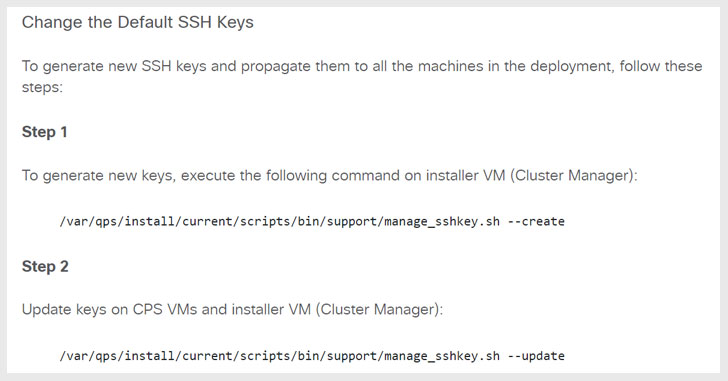
Cisco Policy Suite Releases 21.2.0 and later will also
automatically create new SSH keys during installation, while
requiring a manual process to change the default SSH keys for
devices being upgraded from 21.1.0.
Also addressed by Cisco are multiple critical vulnerabilities[3] affecting web-based
management interface of the Cisco Catalyst Passive Optical Network
(PON) Series Switches Optical Network Terminal (ONT) that could
enable an unauthenticated, remote attacker to log in using an
inadvertent debugging account existing in the device and take over
control, perform a command injection, and modify the configuration
of the device.
The vulnerabilities impact the following devices —
- Catalyst PON Switch CGP-ONT-1P
- Catalyst PON Switch CGP-ONT-4P
- Catalyst PON Switch CGP-ONT-4PV
- Catalyst PON Switch CGP-ONT-4PVC
- Catalyst PON Switch CGP-ONT-4TVCW
Marco Wiorek of Hotzone GmbH has been credited with reporting
the three vulnerabilities that have been assigned the identifiers
CVE-2021-34795 (CVSS score: 10.0),
CVE-2021-40113 (CVSS score: 10.0), and
CVE-2021-40112 (CVSS score: 8.6).
Lastly, Cisco has remediated two more high-severity flaws in
Cisco Small Business Series Switches and Cisco AsyncOS that could
allow unauthenticated, remote adversaries to gain unauthorized
access to the web-based management interface of the switches and
carry out a denial of service (DoS) attack —
- CVE-2021-34739[4] (CVSS score: 8.1) –
Cisco Small Business Series Switches session credentials replay
vulnerability - CVE-2021-34741[5] (CVSS score: 7.5) –
Cisco Email Security Appliance (ESA) denial of service
vulnerability
References
- ^
security
updates (tools.cisco.com) - ^
CVE-2021-40119
(tools.cisco.com) - ^
multiple
critical vulnerabilities (tools.cisco.com) - ^
CVE-2021-34739
(tools.cisco.com) - ^
CVE-2021-34741
(tools.cisco.com)