
Cybersecurity researchers have disclosed a security flaw in the
Linux Kernel’s Transparent Inter Process Communication (TIPC[1]) module that could
potentially be leveraged both locally as well as remotely to
execute arbitrary code within the kernel and take control of
vulnerable machines.
The heap overflow vulnerability “can be exploited locally or
remotely within a network to gain kernel privileges, and would
allow an attacker to compromise the entire system,” cybersecurity
firm SentinelOne said[2]
in a report published today and shared with The Hacker News.
TIPC is a transport layer protocol[3]
designed[4]
for nodes running in dynamic cluster environments to reliably
communicate with each other in a manner that’s more efficient and
fault-tolerant than other protocols such as TCP. The vulnerability
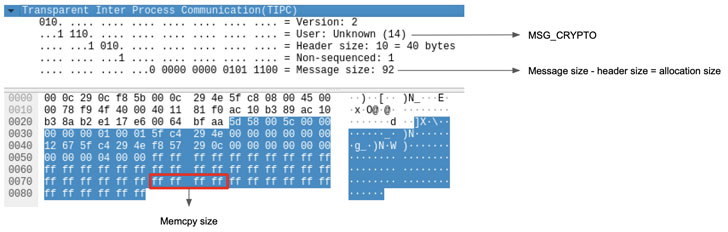
identified by SentinelOne has to do with a new message type called
“MSG_CRYPTO[5]” that was introduced in
September 2020 and enables peer nodes in the cluster to send
cryptographic keys.
While the protocol has checks in place to validate such messages
after decryption to ensure that a packet’s actual payload size
doesn’t exceed that of the maximum user message size and that the
latter is greater than the message header size, no restrictions
were found to be placed on the length of the key (aka ‘keylen’)
itself, resulting in a scenario where “an attacker can create a
packet with a small body size to allocate heap memory, and then use
an arbitrary size in the ‘keylen’ attribute to write outside the
bounds of this location.”
There is no evidence that the flaw has been abused in real-world
attacks to date, and following responsible disclosure on October
19, the issue has been addressed in Linux Kernel version 5.15
released on October 31, 2021.
“The function tipc_crypto_key_rcv is used to parse MSG_CRYPTO
messages to receive keys from other nodes in the cluster in order
to decrypt any further messages from them,” Linux kernel
maintainers sai\d[6]
in a fix pushed late last month. “This patch verifies that any
supplied sizes in the message body are valid for the received
message.”
“While TIPC itself isn’t loaded automatically by the system but
by end users, the ability to configure it from an unprivileged
local perspective and the possibility of remote exploitation makes
this a dangerous vulnerability for those that use it in their
networks,” SentinelOne researcher Max Van Amerongen said.