
Unidentified threat actors breached a server running an
unpatched, 11-year-old version of Adobe’s ColdFusion 9 software in
minutes to remotely take over control and deploy file-encrypting
Cring ransomware on the target’s network 79 hours after the
hack.
The server, which belonged to an unnamed services company, was
used to collect timesheet and accounting data for payroll as well
as to host a number of virtual machines, according to a report
published by Sophos and shared with The Hacker News. The attacks
originated from an internet address assigned to the Ukrainian ISP
Green Floid.
“Devices running vulnerable, outdated software are
low-hanging-fruit for cyberattackers looking for an easy way into a
target,” Sophos principal researcher Andrew Brandt said[1]. “The surprising thing
is that this server was in active daily use. Often the most
vulnerable devices are inactive or ghost machines, either forgotten
about or overlooked when it comes to patching and upgrades.”
The British security software firm said the “rapid break-in” was
made possible by exploiting an 11-year-old installation of Adobe
ColdFusion 9 running on Windows Server 2008, both of which have
reached end-of-life.
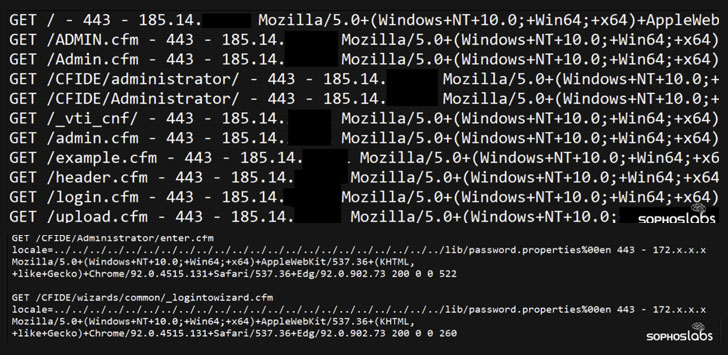
Upon gaining an initial foothold, the attackers used a wide
range of sophisticated methods to conceal their files, inject code
into memory, and cover their tracks by overwriting files with
garbled data, not to mention disarm security products by
capitalizing on the fact that tamper-protection functionalities
were turned off.
Specially, the adversary took advantage of CVE-2010-2861[2], a set of directory
traversal vulnerabilities in the administrator console in Adobe
ColdFusion 9.0.1 and earlier that could be abused by remote
attackers to read arbitrary files, such as those containing
administrator password hashes (“password.properties”).
In the next stage, the bad actor is believed to have exploited
another vulnerability in ColdFusion, CVE-2009-3960[3], to upload a malicious
Cascading Stylesheet (CSS) file to the server, consequently using
it to load a Cobalt Strike Beacon executable. This binary, then,
acted as a conduit for the remote attackers to drop additional
payloads, create a user account with admin privileges, and even
disable endpoint protection systems and anti-malware engines like
Windows Defender, before commencing the encryption process.
“This is a stark reminder that IT administrators benefit from
having an accurate inventory of all their connected assets and
cannot leave out-of-date critical business systems facing the
public internet,” Brandt said. “If organizations have these devices
anywhere on their network, they can be sure that cyberattackers
will be attracted to them.”
References
- ^
said
(news.sophos.com) - ^
CVE-2010-2861
(nvd.nist.gov) - ^
CVE-2009-3960
(nvd.nist.gov)