
Cybersecurity researchers on Tuesday disclosed details of an
unpatched vulnerability in macOS Finder that could be abused by
remote adversaries to trick users into running arbitrary commands
on the machines.
“A vulnerability in macOS Finder allows files whose extension is
inetloc to execute arbitrary commands, these files can be embedded
inside emails which if the user clicks on them will execute the
commands embedded inside them without providing a prompt or warning
to the user,” SSD Secure Disclosure said[1]
in a write-up published today.
Park Minchan, an independent security researcher, has been
credited with reporting the vulnerability which affects macOS
versions of Big Sur and prior.

The weakness arises due to the manner macOS processes INETLOC
files — shortcuts to internet locations such as RSS feeds or Telnet
connections containing username and password for SSH — resulting in
a scenario that allows commands embedded in those files to be
executed without any warning.
“The case here INETLOC is referring to a ‘file://’ protocol
which allows running locally (on the user’s computer) stored
files,” SSD said. “If the INETLOC file is attached to an email,
clicking on the attachment will trigger the vulnerability without
warning.”
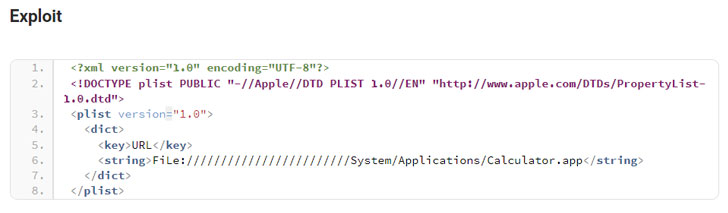
Although newer versions of macOS have blocked the ‘file://’
prefix, using ‘File://’ or ‘fIle://’ has been found to circumvent
the check effectively. We have reached out to Apple, and we will
update the story if we hear back.