
A sophisticated social engineering attack undertaken by an
Iranian-state aligned actor targeted think tanks, journalists, and
professors with an aim to solicit sensitive information by
masquerading as scholars with the University of London’s School of
Oriental and African Studies (SOAS).
Enterprise security firm Proofpoint attributed the campaign —
called “Operation SpoofedScholars” — to the advanced
persistent threat tracked as TA453[1], which is also known by
the aliases APT35 (FireEye), Charming Kitten (ClearSky), and
Phosphorous (Microsoft). The government cyber warfare group is
suspected to carry out intelligence efforts on behalf of the
Islamic Revolutionary Guard Corps (IRGC).
“Identified targets included experts in Middle Eastern affairs
from think tanks, senior professors from well-known academic
institutions, and journalists specializing in Middle Eastern
coverage,” the researchers said in a technical write-up[2]
shared with The Hacker News. “The campaign shows a new escalation
and sophistication in TA453’s methods.”
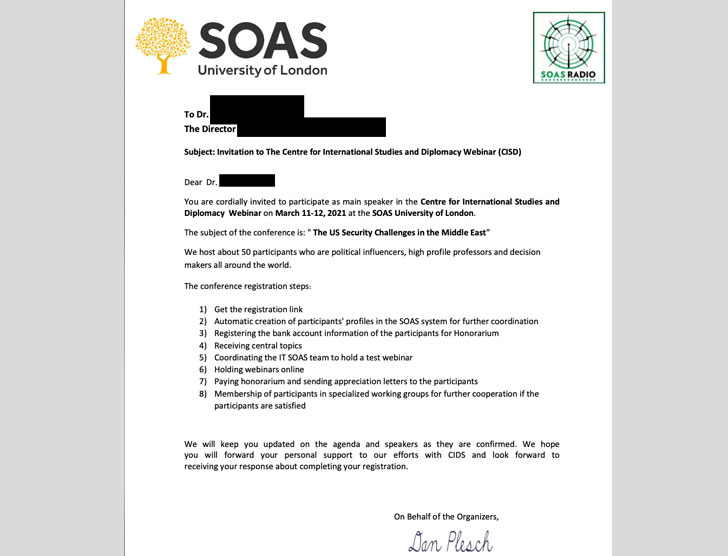
On a high level, the attack chain involved the threat actor
posing as British scholars to a group of highly selective victims
in an attempt to entice the target into clicking on a registration
link to an online conference that’s engineered to capture a variety
of credentials from Google, Microsoft, Facebook, and Yahoo.
To lend it an air of legitimacy, the credential phishing
infrastructure was hosted on a genuine but compromised website
belonging to the University of London’s SOAS Radio, using which
personalized credential harvesting pages disguised as registration
links were then delivered to unsuspecting recipients.
At least in one instance, TA453 is said to have sent a
credential harvesting email to a target to their personal email
account. “TA453 strengthened the credibility of the attempted
credential harvest by utilizing personas masquerading as legitimate
affiliates of SOAS to deliver the malicious links,” the researchers
said.
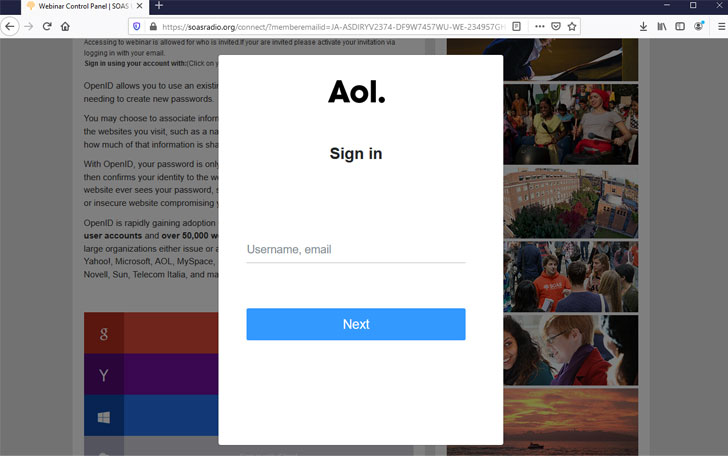
Some of the SOAS scholars who were impersonated included
Dr. Hanns Bjoern Kendel[3], an associate professor
of diplomatic studies and international relations, and Dr. Tolga Sinmazdemir[4], a senior lecturer in
political methodology.
Interestingly, TA453 also insisted that the targets sign in to
register for the webinar when the group was online, raising the
possibility that the attackers were “planning on immediately
validating the captured credentials manually.” The attacks are
believed to have commenced as far back as January January 2021,
before the group subtly shifting their tactics in subsequent email
phishing lures.
This is not the first time the threat actor has launched
credential phishing attacks. Earlier this March, Proofpoint
detailed a “BadBlood[5]” campaign targeting
senior medical professionals who specialized in genetic, neurology,
and oncology research in Israel and the U.S.
“TA453 illegally obtained access to a website belonging to a
world class academic institution to leverage the compromised
infrastructure to harvest the credentials of their intended
targets,” the researchers said. “The use of legitimate, but
compromised, infrastructure represents an increase in TA453’s
sophistication and will almost certainly be reflected in future
campaigns. TA453 continues to iterate, innovate, and collect in
support of IRGC collection priorities.”
References
- ^
TA453
(malpedia.caad.fkie.fraunhofer.de) - ^
write-up
(www.proofpoint.com) - ^
Dr.
Hanns Bjoern Kendel (www.soas.ac.uk) - ^
Dr.
Tolga Sinmazdemir (www.soas.ac.uk) - ^
BadBlood
(www.proofpoint.com)
Read more http://feedproxy.google.com/~r/TheHackersNews/~3/B87P1f3Sg0A/iranian-hackers-posing-as-scholars.html