Cybersecurity researchers have disclosed new security
vulnerabilities in the Etherpad text editor (version 1.8.13) that
could potentially enable attackers to hijack administrator
accounts, execute system commands, and even steal sensitive
documents.
The two flaws — tracked as CVE-2021-34816 and
CVE-2021-34817 — were discovered and reported on June 4 by
researchers from SonarSource, following which patches have been
shipped for the latter in version 1.8.14[1]
of Etherpad released on July 4.
Etherpad is a real-time collaborative interface that enables a
document to be edited simultaneously by multiple authors. It is an
open-source alternative to Google Docs that can be hosted on your
own servers.
“The XSS vulnerability allows attackers to take over Etherpad
users, including admins. This can be used to steal or manipulate
sensitive data,” SonarSource vulnerability researcher Paul Gerste
said[2]
in a report shared with The Hacker News.
“The argument injection vulnerability allows attackers to
execute arbitrary code on the server, which would allow [them] to
steal, modify or delete all data, or to target other internal
systems that are reachable from the server.”
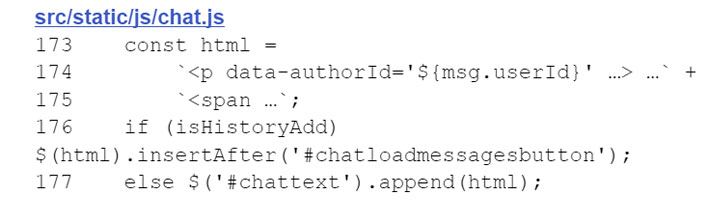
Specifically, the XSS vulnerability (CVE-2021-34817) resides in
the chat feature offered by Etherpad, with the “userId[3]” property of a chat
message — i.e., a unique identifier associated with a document
author — rendered on the front-end without properly escaping
special characters, thus permitting an adversary to insert a
malicious JavaScript payload into the chat history and perform
actions as a victim user.
CVE-2021-34816, on the other hand, relates to how Etherpad
manages plugins, wherein the name of the package to be installed
via the “npm install[4]” command is not
adequately sanitized, leading to a scenario that could allow an
attacker to “specify a malicious package from the NPM repository or
to simply use a URL that points to a package on the attacker’s
server.”
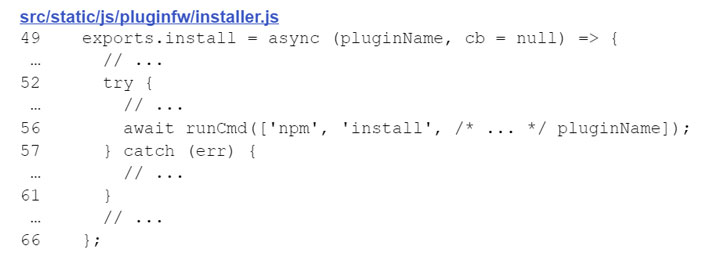
The consequence of successful exploitation of CVE-2021-34816 is
the execution of arbitrary code and system commands, thus
completely compromising the Etherpad instance and its data.
Concerningly, both vulnerabilities can be chained together by an
attacker first to take over an administrator account and then use
those privileges to gain a shell and execute malicious code on the
server.
“Fixed a persistent XSS vulnerability in the Chat component,”
Etherpad maintainers said in the release notes for version 1.8.14.
“In case you can’t update to 1.8.14 directly, we strongly recommend
to cherry-pick [commit] a796811[5].” It’s worth pointing
out that the argument injection vulnerability remains unpatched,
although the researchers note that the flaw is “significantly
harder to exploit on its own.”
The research highlights “how important data validation and
sanitization is for avoiding such flaws during development,” Gerste
said, adding, “the smallest coding mistake can be the first
stepping stone for an attacker to launch further attacks against
the software.”
Etherpad users are highly advised to update their installations
to version 1.8.14 to mitigate the risk associated with the
flaw.
References
- ^
version
1.8.14 (github.com) - ^
said
(blog.sonarsource.com) - ^
userId
(etherpad.org) - ^
npm
install (docs.npmjs.com) - ^
a796811
(github.com)