
Bolstering password policies in your organization is an
important part of a robust cybersecurity strategy. Cybercriminals
are using compromised accounts as one of their favorite tactics to
infiltrate business-critical environments; as we’ve seen in recent
news, these attacks can be dangerous and financially impactful.
Unfortunately, account compromise is a very successful attack
method and requires much less effort than other attack vectors.
One of the essential types of password protection recommended by
noted cybersecurity standards is breached password
detection. Hackers often use known breached password lists
in credential stuffing or password spraying attacks.
Here are some critical criteria to consider when your sysadmins
are evaluating breached password protection solutions.
Breached password recommendations
In the last few years, password security recommendations have
evolved past the traditional recommendations regarding password
security.
Businesses have used Microsoft Active Directory for years to
implement password policies in the organization. Standard Active
Directory password policies include minimal password configuration
settings.
Below is an example of the settings offered with a conventional
Active Directory Password Policy:
- Enforce password history
- Maximum password age
- Minimum password age
- Minimum password length
- Minimum password length audit
- Password must meet complexity requirements
- Store password using reversible encryption
By default, Active Directory Password Policies do not include a
solution to implement breached password protection.
 |
| Active Directory Password Policy settings |
Why is it important for businesses to start thinking about
breached password protection? Let’s look at best practice
recommendations from leading authorities in cybersecurity
guidance.
New password policy recommendations
As mentioned, traditional password policies created using Active
Directory are limited in features and capabilities. These allow
creating basic password policies with standard length, complexity,
age, and other requirements. However, there is no way to use native
functionality to implement breached password protection.
While there is a means for implementing a password filter
.dll in Active Directory[1] to provision password
dictionary protection, this is a manual process relying on the
development of custom password filter .dll files.
New password policy guidance from leading cybersecurity
authorities such as the National Institute of Standards and
Technology (NIST) recommend breached password protection.
The NIST Special Publication 800-63B SP 800-63B Section 5.1.1.2
paragraph 9 states:
“Verifiers SHOULD NOT impose other composition rules (e.g.,
requiring mixtures of different character types or prohibiting
consecutively repeated characters) for memorized secrets. Verifiers
SHOULD NOT require memorized secrets to be changed arbitrarily
(e.g., periodically). However, verifiers SHALL
force a change if there is evidence of compromise of the
authenticator.”
Basically, NIST’s guidance recommends that organizations should
force a password change if there is evidence of a breach. For
businesses to have proof of a password breach, they must have a way
to monitor the password landscape for breached passwords. In
addition to monitoring for passwords to become breached, as users
choose new passwords, the new password choices need to be
checked.
Evaluating breached password detection services
Breached password detection[2] is a recommended best
practice for an additional layer of cyberattack prevention.
Consider the following functions as must-haves to pay close
attention to when choosing a solution:
- Ease of deployment
- Proactive monitoring
- Proactive password changes
- Breached password database size
- Integration with current Active Directory password
policies - Ease of deployment
An essential consideration businesses need to make when choosing
a third-party breached password solution is deployment ease. Look
for solutions that are easily deployed using existing Active
Directory infrastructure. Solutions that are difficult to deploy
will likely lead to configuration issues and challenges with
implementation and time to value. Look for solutions that make use
of existing Active Directory infrastructure along with Group Policy
that allows quickly making use of existing policies and
infrastructure.
1 — Proactive monitoring
One of the essential requirements for breached password
protection is proactive monitoring. Organizations need a solution
that checks a password during the password set operation and
proactively monitors the password landscape to find passwords that
may become breached. This functionality helps to ensure passwords
that may not be breached during creation, but become breached
later, are correctly identified and can be remediated.
2 — Proactive password changes
Dovetailing into the proactive monitoring of breached passwords
in the environment, organizations need to look for a breached
password protection solution that proactively requires end-users to
change their password if these become breached. This feature helps
ensure any passwords that become breached in the environment are
remediated as quickly as possible.
3 — Breached password database size
Keep in mind that all breached password protection services are
not equal in the number of breached passwords checked. Breached
password databases may vary between different services. The more
extensive the breached password database, the better for protecting
against breached passwords. If the quantity of breached passwords
isn’t transparently communicated, ask the vendor directly how many
are included in their backend lists.
4 — Integration with current Active Directory password
policies
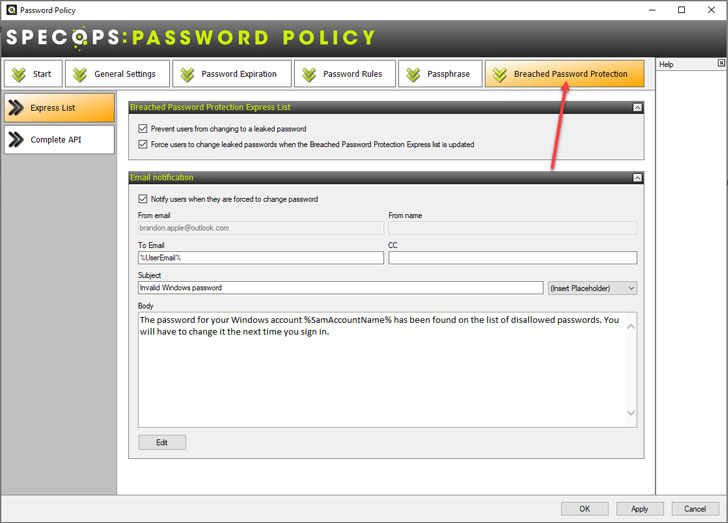 |
| Specops Breached Password Protection |
Look for a breached password protection solution that can
integrate with current Active Directory password policies. It means
you can leave GPO assignments in place that assign various password
policies to specific users and will help to prevent “reinventing
the wheel.”
Specops Breached Password Protection
The Specops Password Policy solution[3] allows organizations to
have powerful breached password protection as part of the
environment’s password security. Features include all the top
requirements, like:
- Proactive breached password monitoring and password change
enforcement - Easily to deploy and integrates with existing Active Directory
GPO-based password policies - Downloadable breached password database or API-based
protection - Managed database of over 2-billion passwords and growing
- With the API-based approach, you get real-time breached
password protection for your organization’s passwords
Using Specops Password Policy with Breached Password Protection,
you can easily rollout breached password protection using GPO-based
Active Directory Password Policies that are already in place.
To delve into the Specops Password Policy with Breached Password
Protection, start a free trial anytime[4].
References
- ^
.dll in
Active Directory (docs.microsoft.com) - ^
Breached
password detection (specopssoft.com) - ^
Specops
Password Policy solution (specopssoft.com) - ^
start a
free trial anytime (specopssoft.com)
Read more http://feedproxy.google.com/~r/TheHackersNews/~3/9kyiXACgOkU/using-breached-password-detection.html