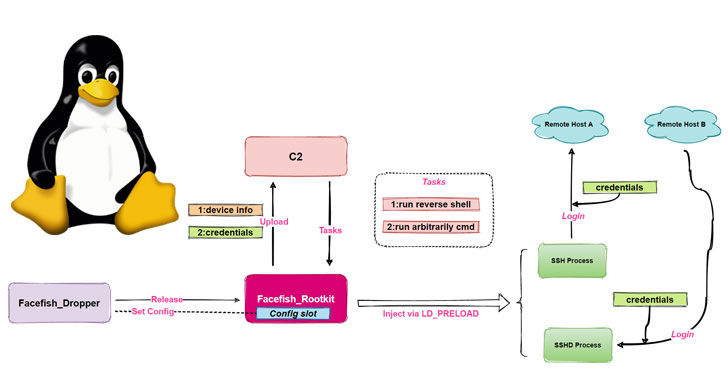
Cybersecurity researchers have disclosed a new backdoor program
capable of stealing user login credentials, device information and
executing arbitrary commands on Linux systems.
The malware dropper has been dubbed “Facefish” by Qihoo
360 NETLAB team owing its capabilities to deliver different
rootkits at different times and the use of Blowfish[1]
cipher to encrypt communications to the attacker-controlled
server.
“Facefish consists of 2 parts, Dropper and Rootkit, and its main
function is determined by the Rootkit module, which works at the
Ring 3[2]
layer and is loaded using the LD_PRELOAD[3]
feature to steal user login credentials by hooking ssh/sshd program
related functions, and it also supports some backdoor functions,”
the researchers said[4].
The NETLAB research builds on a previous analysis published[5]
by Juniper Networks on April 26, which documented an attack chain
targeting Control Web Panel (CWP, formerly CentOS Web Panel) to
inject an SSH implant with data exfiltration capabilities.
Facefish goes through a multi-stage infection process, which
commences with a command injection against the CWP to retrieve a
dropper (“sshins”) from a remote server, which then releases a
rootkit that ultimately takes charge of collecting and transmitting
sensitive information back to the server, in addition to awaiting
further instructions issued by the command-and-control (C2)
server.
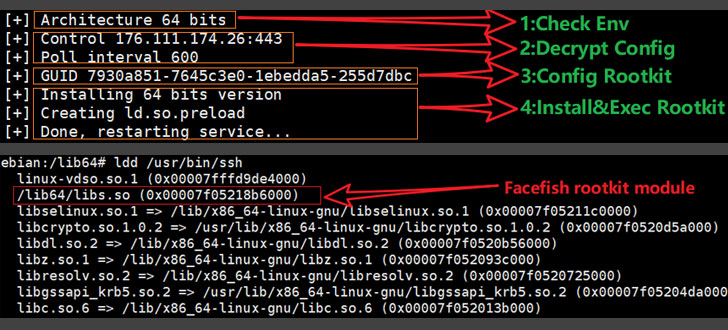
For its part, the dropper comes with its own set of tasks, chief
among being detecting the runtime environment, decrypting a
configuration file to get C2 information, configuring the rootkit,
and starting the rootkit by injecting it into the secure shell
server process (sshd).
Rootkits are particularly dangerous as they allow attackers to
gain elevated privileges in the system, allowing them to interfere
with core operations conducted by the underlying operating system.
This ability of rootkits to camouflage into the fabric of the
operating system gives attackers a high level of stealth and
evasion.
Facefish also employs a complex communication protocol and
encryption algorithm, using instructions starting with 0x2XX to
exchange public keys and BlowFish for encrypting communication data
with the C2 server. Some of the C2 commands sent by the server are
as follows –
- 0x300 – Report stolen credential information
- 0x301 – Collect details of “uname[6]” command
- 0x302 – Run reverse shell
- 0x310 – Execute any system command
- 0x311 – Send the result of bash execution
- 0x312 – Report host information
NETLAB’s findings come from an analysis of an ELF sample file it
detected in February 2021. Other indicators of compromise
associated with the malware can be accessed here[7].