
Microsoft on Thursday warned of a “massive email campaign”
that’s pushing a Java-based STRRAT malware to steal confidential
data from infected systems while disguising itself as a ransomware
infection.
“This RAT is infamous for its ransomware-like behavior of
appending the file name extension .crimson to files without
actually encrypting them,” the Microsoft Security Intelligence team
said[1]
in a series of tweets.
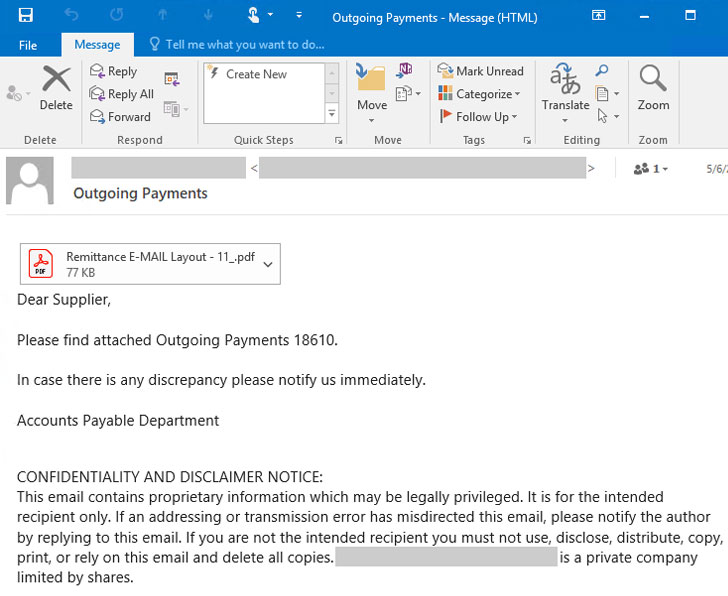
The new wave of attacks, which the company spotted last week,
commences with spam emails sent from compromised email accounts
with “Outgoing Payments” in the subject line, luring the recipients
into opening malicious PDF documents that claim to be remittances,
but in reality, connect to a rogue domain to download the STRRAT
malware.
Besides establishing connections to a command-and-control server
during execution, the malware comes with a range of features that
allow it to collect browser passwords, log keystrokes, and run
remote commands and PowerShell scripts.
STRRAT[2]
first emerged in the threat landscape in June 2020, with German
cybersecurity firm G Data observing the Windows malware (version
1.2) in phishing emails containing malicious Jar[3]
(or Java Archive) attachments.
“The RAT has a focus on stealing credentials of browsers and
email clients, and passwords via keylogging,” G Data malware
analyst Karsten Hahn detailed[4]. “It supports the
following browsers and email clients: Firefox, Internet Explorer,
Chrome, Foxmail, Outlook, Thunderbird.”
Its ransomware capabilities are at best rudimentary in that the
“encryption” stage only renames files by suffixing the “.crimson”
extension. “If the extension is removed, the files can be opened as
usual,” Kahn added.
Microsoft also notes that version 1.5 is more obfuscated and
modular than previous versions, suggesting that the attackers
behind the operation are actively working to improvise their
toolset. But the fact that the bogus encryption behavior remains
unchanged signals that the group may be aiming to make quick money
off unsuspecting users by means of extortion.
The indicators of compromise (IoCs) associated with the campaign
can be accessed via GitHub here[5].
References
Read more http://feedproxy.google.com/~r/TheHackersNews/~3/rBj4zUNjEc0/microsoft-warns-of-data-stealing.html