Mozilla has begun rolling out a new security feature for its
Firefox browser in nightly and beta channels that aims to protect
users against a new class of side-channel attacks from malicious
sites.
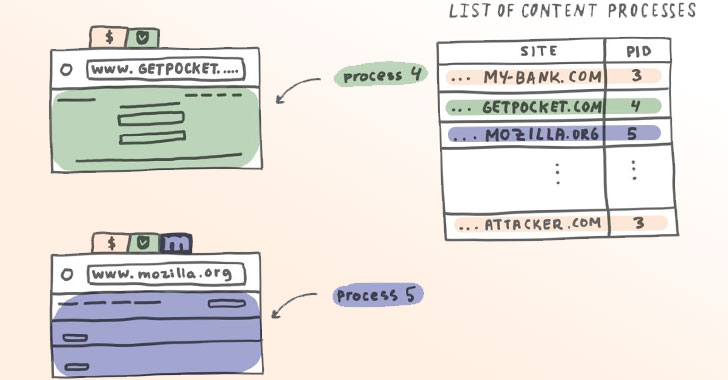
Called “Site Isolation,” the implementation loads each website
separately in its own operating system process and, as a result,
prevents untrusted code from a rogue website from accessing
confidential information stored in other sites.
“This fundamental redesign of Firefox’s Security architecture
extends current security mechanisms by creating operating system
process-level boundaries for all sites loaded in Firefox for
Desktop,” Mozilla said[1]
in a statement. “Isolating each site into a separate operating
system process makes it even harder for malicious sites to read
another site’s secret or private data.”
The motivation for Site Isolation can be traced all the way back
to January 2018 when Spectre and Meltdown
vulnerabilities[2]
were publicly disclosed, forcing browser vendors and chipmakers to
incorporate defenses to neutralize attacks that could break the
boundaries between different applications and allow an adversary to
read passwords, encryption keys, and other valuable information
directly from a computer’s kernel memory.
Troublingly, such timing side-channel attacks could be launched remotely[3]
via websites running malicious JavaScript code, necessitating
browser makers, including Mozilla, to offer mitigations[4]
by reducing the precision of time-measuring
functions[5]. However, the current
patches for Spectre have been a mere “band-aid” and don’t offer
protection against all theoretical variants of the attacks.
“Despite existing security mitigations, the only way to provide
memory protections necessary to defend against Spectre-like attacks
is to rely on the security guarantees that come with isolating
content from different sites using the operating system’s process
separation,” Mozilla’s Anny Gakhokidze said[6].
Thus began Mozilla’s initiative for Site Isolation in April 2018
under the moniker Project
Fission[7]. While Firefox’s current
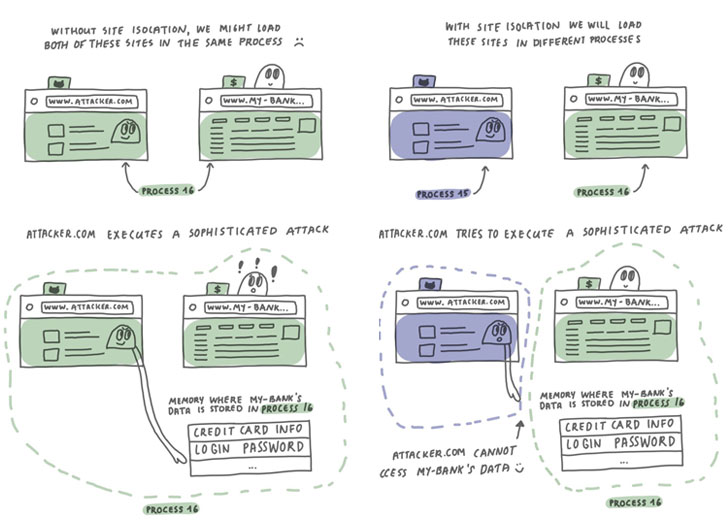
architecture allows the privileged “parent” process to spawn eight
web content processes, it could also open the door to a scenario
where two completely different websites end up in the same process
and, therefore, share process memory, thereby putting legitimate
websites at risk of speculative execution attacks.
This also means a web page that comes embedded with multiple
subframes[8]
from different sites (e.g., ad slots in web pages) will all share
the same process memory, in turn enabling a top-level site to
obtain secrets from an embedded subframe it shouldn’t have access
to in the first place, and vice-versa.
This is where Site Isolation comes in. It loads every website
into its own process, including those that are embedded into the
page, and isolates their memory from each other, thus effectively
making it difficult for a malicious domain from accessing
information entered in a different domain.
Besides hardening the security of Firefox by offering operating
system-level process separation for each site, Site Isolation is
also expected to bring other performance benefits, including
efficient use of underlying hardware and improved stability, as a
subframe or a tab crash will no longer affect other websites or
processes.
Users running Firefox Nightly builds can enable the feature by
navigating to “about:preferences#experimental” and ticking the
“Fission (Site Isolation)” checkbox. Those on Firefox Beta can do
so by heading to “about:config” and setting “fission.autostart” to
“true.”
References
- ^
said
(blog.mozilla.org) - ^
Spectre
and Meltdown vulnerabilities
(thehackernews.com) - ^
launched
remotely (security.googleblog.com) - ^
mitigations
(thehackernews.com) - ^
precision of time-measuring
functions (blog.mozilla.org) - ^
said
(hacks.mozilla.org) - ^
Project
Fission (wiki.mozilla.org) - ^
subframes
(support.google.com)
Read more http://feedproxy.google.com/~r/TheHackersNews/~3/YLGFHQbeU2o/mozilla-begins-rolling-out-site.html