A total of 158 privacy and security issues have been identified
in 58 Android stalkware apps from various vendors that could enable
a malicious actor to take control of a victim’s device, hijack a
stalker’s account, intercept data, achieve remote code execution,
and even frame the victim by uploading fabricated evidence.
The new findings, which come from an analysis of 86 stalkerware
apps for the Android platform undertaken by Slovak cybersecurity
firm ESET, highlight the unintended consequences of a practice
that’s not only unethical but in the process could also expose
private and intimate information of the victims and leave them at
risk of cyberattacks and fraud.
“Since there could be a close relationship between stalker and
victim, the stalker’s private information could also be exposed,”
ESET researcher Lukas Stefanko said[1]
in a Monday write-up. “During our research, we identified that some
stalkerware keeps information about the stalkers using the app and
gathered their victims’ data on a server, even after the stalkers
requested the data’s deletion.”
To date, only six vendors have fixed the issues that were
identified in their apps. 44 vendors chose not to acknowledge the
disclosures, while seven others claimed they intend to address the
flaws in an upcoming update. “One vendor decided not to fix the
reported issues,” Stefanko said.
Stalkerware, also called spouseware or spyware, refers to
invasive software that enables individuals to remotely monitor the
activities on another user’s device without the individual’s
consent with the goal of facilitating intimate partner
surveillance, harassment, abuse, stalking, and violence.

Based on telemetry data gathered by ESET, Android spyware
detection surged by 48% in 2020 when compared to 2019, which
witnessed a five-fold increase in stalkerware detections from 2018.
Although Google put in place restrictions[2]
on advertising[3]
for spyware and surveillance technology, stalkerware providers have
managed to slip past such defenses by masquerading as child,
employee, or women safety apps.
Among the most prevalent issues uncovered are as follows —
- Apps from nine different vendors are based on an open-source
Android spyware called Droid-Watcher, with one vendor using a
Metasploit payload as a monitoring app. - Some apps have hardcoded license keys in cleartext, allowing
easy theft of software. Other apps analyzed by ESET disable
notifications and Google Play Protect to weaken the device’s
security intentionally. - 22 apps transmit users’ personally identifiable information
over an unencrypted connection to the stalkerware server, thereby
permitting an adversary on the same network to stage a
man-in-the-middle attack and change transmitted data. - 19 apps store sensitive information, such as keystroke logs,
photos, recorded phone calls, and audio, calendar events, browser
history, contact lists, on external media. This could allow any
third-party app with access to external storage to read these files
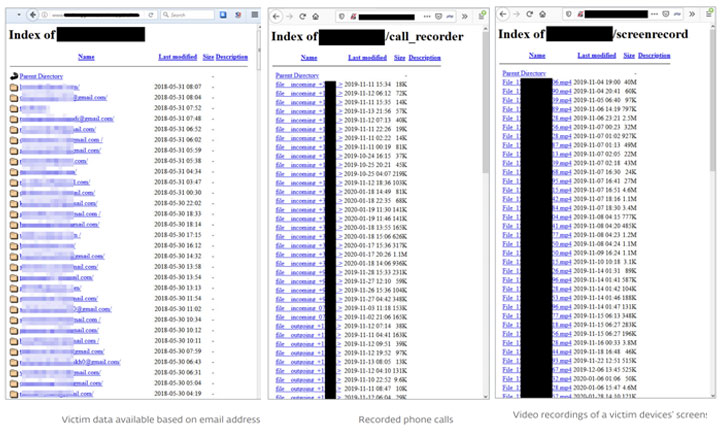
without additional permission. - 17 apps expose user information stored in the servers to
unauthorized users without requiring any authentication, granting
the attacker full access to call logs, photos, email addresses, IP
logs, IMEI numbers, phone numbers, Facebook and WhatsApp messages,
and GPS locations. - 17 apps leak client information through their servers, thus
allowing a victim to retrieve information about the stalker using
the device’s IMEI number and creating an “opportunity to
brute-force device IDs and dump all the stalkerware clients.” - 15 apps transmit unauthorized data from a device to the servers
immediately upon installation and even before the stalker registers
and sets up an account. - 13 apps have insufficient verification protections for uploaded
data from a victim phone, with the apps solely relying on IMEI
numbers for identifying the device during communications.
The last issue is also concerning in that it be exploited by an
attacker to intercept and falsify data. “With appropriate
permission, those identifiers can be easily extracted by other apps
installed on a device and could then be used to upload fabricated
text messages, photos and phone calls, and other fictitious data to
the server, to frame victims or make their lives more difficult,”
Stefanko said.
References
- ^
said
(www.welivesecurity.com) - ^
restrictions
(support.google.com) - ^
advertising
(support.google.com)