A financially motivated cybercrime gang has unleashed a
previously undocumented banking trojan, which can steal credentials
from customers of 70 banks located in various European and South
American countries.
Dubbed “Bizarro[1]” by Kaspersky
researchers, the Windows malware is “using affiliates or recruiting
money mules to operationalize their attacks, cashing out or simply
to helping [sic] with transfers.”
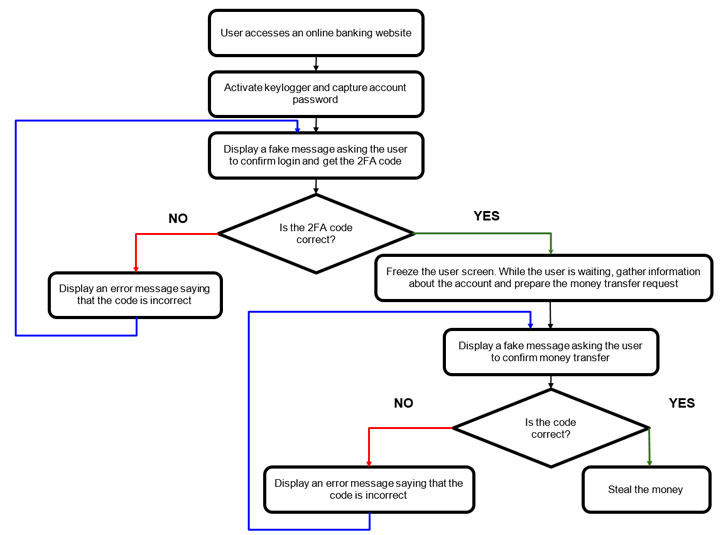
The campaign consists of multiple moving parts, chief among them
being the ability to trick users into entering two-factor
authentication codes in fake pop-up windows that are then sent to
the attackers, as well as its reliance on social engineering lures
to convince visitors of banking websites into downloading a
malicious smartphone app.
Bizarro, which uses compromised WordPress, Amazon, and Azure
servers to host the malware, is distributed via MSI packages
downloaded by victims from sketchy links in spam emails. Launching
the package downloads a ZIP archive that contains a DLL written in
Delphi, which subsequently injects the heavily obfuscated implant.
What’s more, the main module of the backdoor is configured to
remain idle until it detects a connection to one of the hardcoded
online banking systems.
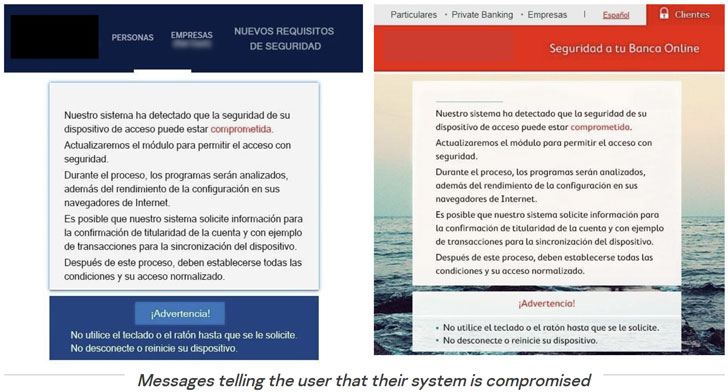
“When Bizarro starts, it first kills all the browser processes
to terminate any existing sessions with online banking websites,”
the researchers said. “When a user restarts the browsers, they will
be forced to re-enter the bank account credentials, which will be
captured by the malware. Another step Bizarro takes in order to get
as many credentials as possible is to disable autocomplete in a
browser.”
While the trojan’s primary function is to capture and exfiltrate
banking credentials, the backdoor is designed to execute 100
commands from a remote server that enables it to harvest all kinds
of information from Windows machines, control the victim’s mouse
and keyboard, log keystrokes, capture screenshots, and even limit
the functionality of Windows.
Bizarro is only the latest example of how Brazilian banking
trojans are increasingly affecting Windows and Android devices,
joining the likes of malware such as Guildma, Javali, Melcoz,
Grandoreiro (collectively called the Tetrade[2]), Amavaldo[3], Ghimob[4], and BRATA[5], while simultaneously
expanding their victimology footprint across South America and
Europe.
“The threat actors behind this campaign are adopting various
technical methods to complicate malware analysis and detection, as
well as social engineering tricks that can help convince victims to
provide personal data related to their online banking accounts,”
the researchers said.