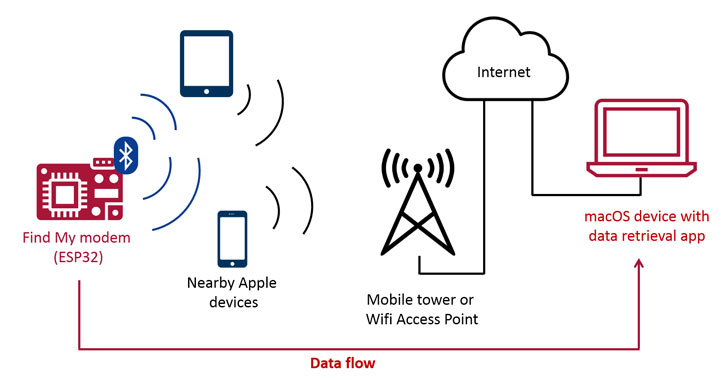
Latest research has demonstrated a new exploit that enables
arbitrary data to be uploaded from devices that are not connected
to the Internet by simply sending “Find My Bluetooth” broadcasts to
nearby Apple devices.
“It’s possible to upload arbitrary data from
non-internet-connected devices by sending Find My [Bluetooth Low
Energy] broadcasts to nearby Apple devices that then upload the
data for you,” Positive Security researcher Fabian Bräunlein
said[1]
in a technical write-up disclosed last week.
“Being inherent to the privacy and security-focused design of
the Find My Offline Finding system, it seems unlikely that this
misuse can be prevented completely.”
The study builds on a previous study by TU Darmstadt published[2]
in March 2021, which disclosed two distinct design and
implementation flaws in Apple’s crowdsourced Bluetooth location
tracking system that could lead to a location correlation attack
and unauthorized access to a user’s location history of the past
seven days.
The investigation was augmented by the release of a framework
called OpenHaystack[3]
that’s designed to let any user create an “AirTag,” enabling
individuals to track personal Bluetooth devices via Apple’s massive
Find My network.
But the reverse engineering of Apple’s Find My offline finding
system also left the door open to the possibility that the protocol
could be emulated to upload arbitrary data to the Internet by
broadcasting the information via Bluetooth beacons that would get
picked up by Apple devices in close physical proximity, and then
subsequently relay the encrypted data to Apple’s servers, from
where a macOS application can retrieve, decode, and display the
uploaded data.
One of the core aspects of Find My is its rotating key scheme
consisting of a pair of public-private keys that are
deterministically changed every 15 minutes, with the public key
sent within the Bluetooth Low Energy advertisement packet.
Thus when nearby Apple devices such as MacBooks, iPhones, and
iPads receive the broadcast, they fetch their own location, then
encrypt the location using the aforementioned public key before
sending the encrypted location report to iCloud along with a hash
of the public key. In the final step, the owner of the lost device
can use a second Apple device signed in with the same Apple ID to
access the approximate location.
The encryption protections mean that not only does Apple not
know which public keys belong to a specific lost device or AirTag,
it also doesn’t have any knowledge of which location reports are
intended for a specific user — hence the above Apple ID
requirement. “The security solely lies in the encryption of the
location reports: The location can only be decrypted with the
correct private key, which is infeasible to brute force and only
stored on the paired Owner Device,” Bräunlein said.
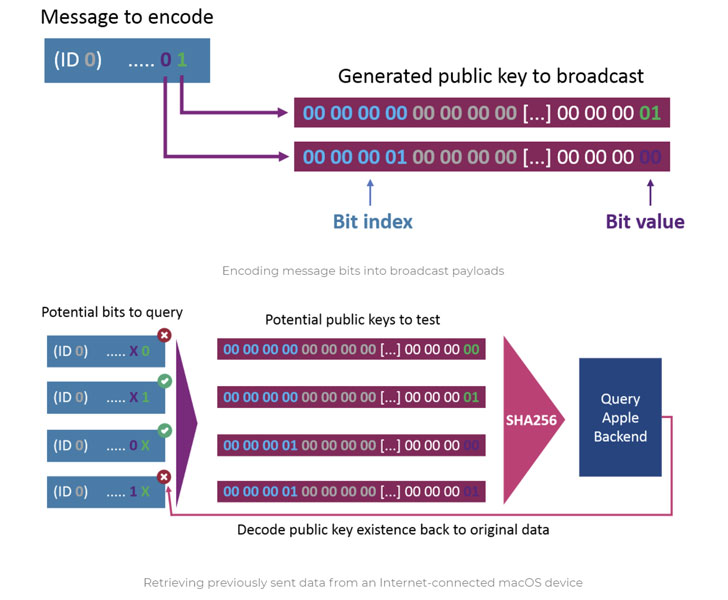
The idea[4], therefore, is to
exploit this gap by encoding a message into the broadcast payloads
and then obtaining them on the other end using a data fetcher
component based on OpenHaystack that decrypts and extracts the
information transmitted from the sender device, say, a
microcontroller.
“When sending, the data is encoded in the public keys that are
broadcasted by the microcontroller. Nearby Apple devices will pick
up those broadcasts and forward the data to an Apple backend as
part of their location reporting. Those reports can later be
retrieved by any Mac device to decode the sent data,” Bräunlein
explained.
While malicious real-world implications of such an exploit may
seem moot, it’s also difficult for Apple to defend against an
attack of this kind due to the end-to-end encrypted nature of the
Find My network. To counter such unintended uses, the researcher
suggests hardening the system in two possible ways, including
authenticating the BLE advertisement and applying rate limits
on-location report retrievals by caching the hashes and ensuring
that the only “16 new key ids are queried per 15 minutes and Apple
ID.” It’s worth noting that there is a limit[5]
of 16 AirTags per Apple ID.
“In the world of high-security networks, where combining lasers
and scanners seems to be a noteworthy technique to bridge the air
gap, the visitor’s Apple devices might also become feasible
intermediaries to exfiltrate data from certain air gapped systems
or Faraday caged rooms,” Bräunlein said.