
An unknown threat actor managed to control more than 27% of the
entire Tor network exit capacity in early February 2021, a new
study on the dark web infrastructure revealed.
“The entity attacking Tor users is actively exploiting tor users
since over a year and expanded the scale of their attacks to a new
record level,” an independent security researcher who goes by the
name nusenu said[1]
in a write-up published on Sunday. “The average exit fraction this
entity controlled was above 14% throughout the past 12 months.”
It’s the latest in a series of efforts undertaken to bring to
light malicious Tor activity since December 2019[2]. The attacks, which are
said to have begun in January 2020, were first documented and exposed[3]
by the same researcher in August 2020.
Tor is open-source software for enabling anonymous communication
on the Internet. It obfuscates the source and destination of a web
request by directing network traffic through a series of relays in
order to mask a user’s IP address and location and usage from
surveillance or traffic analysis. While middle relays typically
take care of receiving traffic on the Tor network and pass it
along, an exit relay is the final node that Tor traffic passes
through before it reaches its destination.
Exit nodes on the Tor network have been subverted in the past to
inject malware such as OnionDuke[4], but this is the first
time a single unidentified actor has managed to control such a
large fraction of Tor exit nodes.
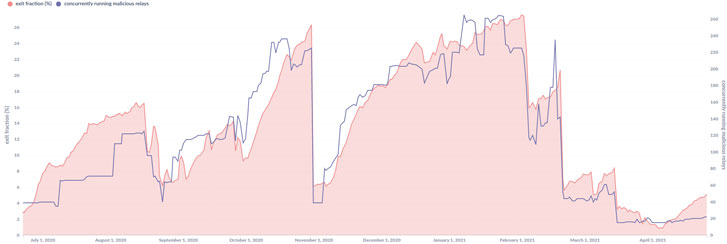
The hacking entity maintained 380 malicious Tor exit relays at
its peak in August 2020, before the Tor directory authorities
intervened to cull the nodes from the network, following which the
activity once again crested early this year, with the attacker
attempting to add over 1,000 exit relays in the first week of May.
All the malicious Tor exit relays detected during the second wave
of the attacks have since been removed.
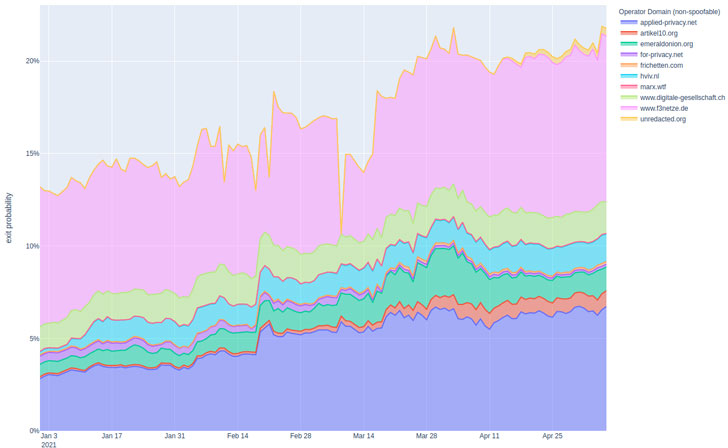
The main purpose of the attack, according to nusenu, is to carry
out “person-in-the-middle” attacks on Tor users by manipulating
traffic as it flows through its network of exit relays.
Specifically, the attacker appears to perform[5]
what’s called SSL stripping[6]
to downgrade traffic heading to Bitcoin mixer[7]
services from HTTPS to HTTP in an attempt to replace bitcoin
addresses and redirect transactions to their wallets instead of the
user-provided bitcoin address.
“If a user visited the HTTP version (i.e. the unencrypted,
unauthenticated version) of one of these sites, they would prevent
the site from redirecting the user to the HTTPS version (i.e. the
encrypted, authenticated version) of the site,” the maintainers of
Tor Project explained[8]
last August. “If the user didn’t notice that they hadn’t ended up
on the HTTPS version of the site (no lock icon in the browser) and
proceeded to send or receive sensitive information, this
information could be intercepted by the attacker.”
To mitigate such attacks, the Tor Project outlined a number of
recommendations, including urging website administrators to enable
HTTPS by default and deploy .onion[9] sites to avoid exit
nodes, adding it’s working on a “comprehensive fix” to disable plain HTTP[10] in Tor Browser.
“The risk of being the target of malicious activity routed
through Tor is unique to each organization,” the U.S. Cybersecurity
Security and Infrastructure Security Agency (CISA) said[11] in an advisory in July
2020. “An organization should determine its individual risk by
assessing the likelihood that a threat actor will target its
systems or data and the probability of the threat actor’s success
given current mitigations and controls.”
“Organizations should evaluate their mitigation decisions
against threats to their organization from advanced persistent
threats (APTs), moderately sophisticated attackers, and low-skilled
individual hackers, all of whom have leveraged Tor to carry out
reconnaissance and attacks in the past,” the agency added.
References
- ^
said
(nusenu.medium.com) - ^
December
2019 (nusenu.medium.com) - ^
documented and exposed
(nusenu.medium.com) - ^
OnionDuke
(malpedia.caad.fkie.fraunhofer.de) - ^
perform
(www.venafi.com) - ^
SSL
stripping (blog.cloudflare.com) - ^
Bitcoin
mixer (en.wikipedia.org) - ^
explained
(blog.torproject.org) - ^
.onion
(en.wikipedia.org) - ^
disable plain HTTP
(gitlab.torproject.org) - ^
said
(us-cert.cisa.gov)