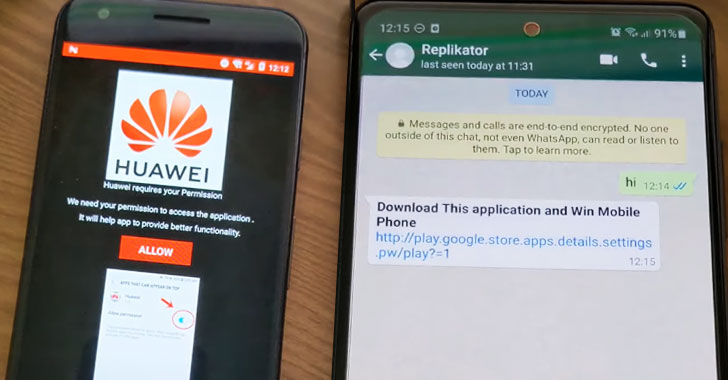
A newly discovered Android malware has been found to propagate
itself through WhatsApp messages to other contacts in order to
expand what appears to be an adware campaign.
“This malware spreads via victim’s WhatsApp by automatically
replying to any received WhatsApp message notification with a link
to [a] malicious Huawei Mobile app,” ESET researcher Lukas
Stefanko[1] said.
The link to the fake Huawei Mobile app, upon clicking, redirects
users to a lookalike Google Play Store website.
Once installed, the wormable app prompts victims to grant it
notification access, which is then abused to carry out the wormable
attack.
Specifically, it leverages WhatApp’s quick reply feature — which
is used to respond to incoming messages directly from the
notifications — to send out a reply to a received message
automatically.
Besides requesting permissions to read notifications, the app
also requests intrusive access to run in the background as well as
to draw over other apps, meaning the app can overlay any other
application running on the device with its own window that can be
used to steal credentials and additional sensitive information.
The functionality, according to Stefanko, is to trick users into
falling for an adware or subscription scam.
Furthermore, in its current version, the malware code is capable
of sending automatic replies only to WhatsApp contacts — a feature
that could be potentially extended in a future update to other
messaging apps that support Android’s quick reply
functionality.
While the message is sent only once per hour to the same
contact, the contents of the message and the link to the app are
fetched from a remote server, raising the possibility that the
malware could be used to distribute other malicious websites and
apps.
“I don’t remember reading and analyzing any Android malware
having such functionality to spread itself via whatsapp messages,”
Stefanko told The Hacker News.
Stefanko said the exact mechanism behind how it finds its way to
the initial set of directly infected victims is not clear; however,
it’s to be noted the wormable malware can potentially expand from a
few devices to many others incredibly quickly.
“I would say it could be via SMS, mail, social media,
channels/chat groups etc,” Stefanko told The Hacker News.
If anything, the development once again underscores the need to
stick to trusted sources to download third-party apps, verify if an
app is indeed built by a genuine developer, and carefully
scrutinize app permissions before installation.
But the fact the campaign cleverly banks on the trust associated
with WhatsApp contacts implies even these countermeasures may not
be enough.
References
- ^
Lukas Stefanko
(twitter.com)