The investigation into how the attackers managed to compromise
SolarWinds’ internal network and poison the company’s software
updates is still underway, but we may be one step closer to
understanding what appears to be a very meticulously planned and
highly-sophisticated supply chain attack.
A new report[1]
published by ReversingLabs today and shared in advance with The
Hacker News has revealed that the operators behind the espionage campaign[2]
likely managed to compromise the software build and code signing
infrastructure of SolarWinds Orion platform as early as October
2019 to deliver the malicious backdoor through its software release
process.
“The source code of the affected library was directly modified
to include malicious backdoor code, which was compiled, signed, and
delivered through the existing software patch release management
system,” ReversingLabs’ Tomislav Pericin said.
Cybersecurity firm FireEye earlier this week detailed[3]
how multiple SolarWinds Orion software updates, released between
March and June 2020, were injected with backdoor code
(“SolarWinds.Orion.Core.BusinessLayer.dll” or SUNBURST) to conduct
surveillance and execute arbitrary commands on target systems.
FireEye has not so far publicly attributed the attack to any
specific nation-state actor, but multiple[4]
media[5]
reports have pinned the intrusion campaign on APT29 (aka Cozy
Bear), a hacker group associated with Russia’s foreign intelligence
service.
Sneaky Injection of Malicious Code
Although the first version containing the tainted Orion software
was traced to 2019.4.5200.9083, ReversingLabs has found that an
earlier version[6]
2019.4.5200.8890, released in October 2019, also included seemingly
harmless modifications that acted as the stepping stone for
delivering the real attack payload down the line.
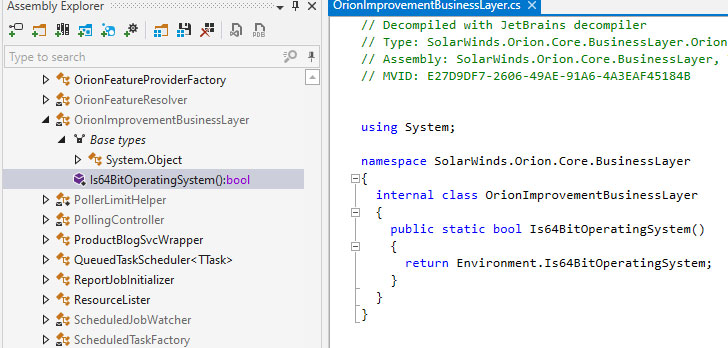 |
| Empty .NET class prior to backdoor code addition [ver. 2019.4.5200.8890] |
The idea, according to Pericin, was to compromise the build
system, quietly inject their own code in the source code of the
software, wait for the company to compile, sign packages and at
last, verify if their modifications show up in the newly released
updates as expected.
Once confirmed, the adversary then took steps to blend the
SUNBURST malware with the rest of the codebase by mimicking
existing functions (GetOrCreateUserID) but adding their own
implementations so as to remain stealthy and invoking them by
modifying a separate class called “InventoryManager” to create a
new thread that runs the backdoor.
What’s more, malicious strings were obscured using a combination
of compression and Base64 encoding in hopes that doing so would
thwart YARA rules from spotting anomalies in the code as well as a
slip through undetected during a software developer review.
“The attackers went through a lot of trouble to ensure that
their code looks like it belongs within the code base,” Pericin
said. “That was certainly done to hide the code from the audit by
the software developers.”
How did the Compromise Happen?
This implies that not only did the attackers have a high degree
of familiarity with the software, but also the fact that its
existing software release management system itself was compromised
— as the class in question was modified at the source code level to
build a new software update containing the backdoored library, then
signed, and ultimately released to the customers.
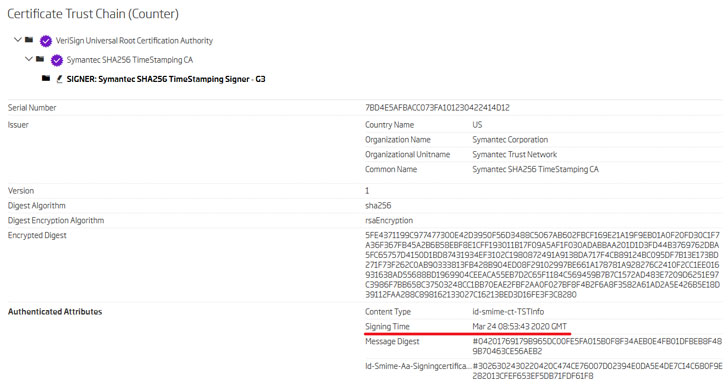
This also raises more questions than it answers in that a change
of this magnitude could only have been possible if either the
version control system was compromised or the tainted software was
placed directly on the build machine.
While it’s not immediately clear how the attackers got access to
the code base, security researcher Vinoth Kumar’s disclosure about
SolarWinds’ update server being accessible with the password
“solarwinds123” assumes new significance given the overlap in
timelines.
Kumar, in a tweet[7]
on December 14, said he notified the company of a publicly
accessible GitHub repository that was leaking the company’s
download website’s FTP credentials in plaintext, adding a hacker
could use the credentials to upload a malicious executable and add
it to a SolarWinds update.
“That Github repo was open to the public since June 17 2018,”
Kumar said, before the misconfiguration was addressed on November
22, 2019.
“SUNBURST illustrates the next generation of compromises that
thrive on access, sophistication and patience,” Pericin concluded.
“For companies that operate valuable businesses or produce software
critical to their customers, inspecting software and monitoring
updates for signs of tampering, malicious or unwanted additions
must be part of the risk management process.”
“Hiding in plain sight behind a globally known software brand or
a trusted business-critical process, gives this method access that
a phishing campaign could only dream to achieve,” he added.
Over 4,000 Sub-domains Compromised by SUNBURST
SolarWinds said up to 18,000 of its customers may have been
impacted by the supply chain attack while urging Orion platform
users to update the software to version 2020.2.1 HF 2 as soon as
possible to secure their environments.
According to security researcher R. Bansal (@0xrb), over
4,000 sub-domains[8]
belonging to prominent businesses and educational institutions were
infected with the SUNBURST backdoor, including those of Intel,
NVIDIA, Kent State University, and Iowa State University.
To make matters worse, malicious code added to an Orion software
update may have gone unnoticed by antivirus software and other
security tools on targeted systems owing to SolarWinds’ own
support advisory[9], which states its
products may not work properly unless their file directories are
exempted from antivirus scans and group policy object (GPO)
restrictions.
“Prolific actors are constantly going after high-revenue
customers like SolarWinds because they see an increased chance of
making larger profits by selling access to ransomware partners and
other buyers,” cybersecurity firm Intel 471 said[10], responding to the
possibility that criminals were selling access to the company’s
networks on underground forums.
“Whether it’s by exploiting vulnerabilities, launching spam
campaigns or leveraging credential abuse, access is typically
advertised and auctioned to the highest bidder for a profit.
Whether this was the motivation for the current SolarWinds incident
remains to be seen.”
References
- ^
report
(blog.reversinglabs.com) - ^
espionage campaign
(thehackernews.com) - ^
detailed
(thehackernews.com) - ^
multiple
(www.washingtonpost.com) - ^
media
(www.reuters.com) - ^
earlier
version (msrc-blog.microsoft.com) - ^
tweet
(twitter.com) - ^
4,000
sub-domains (twitter.com) - ^
support
advisory (support.solarwinds.com) - ^
said
(twitter.com)
Read more http://feedproxy.google.com/~r/TheHackersNews/~3/HPHQs0YyzEs/new-evidence-suggests-solarwinds.html